Hiragana "Za" Coloring Pages


About Hiragana "Za"
"Za" in "Zaru"
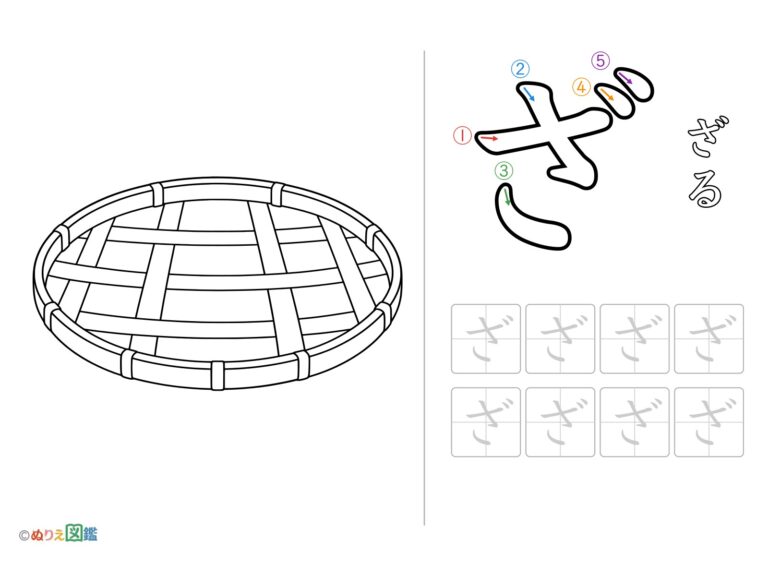
The character on this coloring page is the hiragana Hiragana "Za".
The word is "zaru" (bamboo colander). The picture on the left shows a round zaru made by weaving thin strips of cut bamboo together.
A zaru is a kitchen tool used to drain washed vegetables or to serve boiled soba noodles.
Water slips right through the gaps in the weave.
Hiragana "Za" Comes from "Sa"
Hiragana "Za" is the character "sa" with two dots (voiced sound marks) added.
The original "sa" became the shape it is today as people long ago wrote the kanji 「左」 in a quick, flowing way.
When you add the dots, the clear sound of "sa" changes into the buzzing sound of Hiragana "Za".
Try saying "sa" and Hiragana "Za" out loud to compare them. Can you feel your throat vibrate inside your mouth?
Tips for Writing
You write "sa" in 3 strokes. Draw the horizontal line for stroke 1 going slightly up to the right.
For stroke 2, go straight through the horizontal line, coming down diagonally from the top to the bottom left, and stop.
Start stroke 3 a little away from stroke 2, curve it around at the bottom, and sweep to the right.
At the end, write two dots in the upper right. The secret is to write them small, from left to right, after you finish writing the main character.
Make sure the dots are not too big and do not touch the character. Place them neatly in the empty space at the top right of the grid box.
Words with Hiragana "Za"
Words that start with Hiragana "Za" include zarigani (crayfish), zakuro (pomegranate), zabuton (floor cushion), and zasshi (magazine).
Hiragana "Za" also pops up often in sound words, like heavy rain falling zaa zaa, or the crunching sound of stepping on snow, zaku zaku.
Try playing a game with someone in your family where you take turns saying words that have Hiragana "Za".
Who can find more?
How to Use This Coloring Page
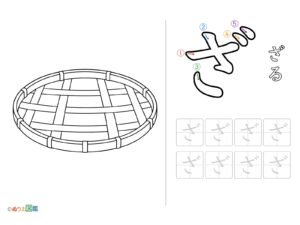
On this coloring page, you will find a picture of a zaru on the left, a big Hiragana "Za" and the vertical word "zaru" on the top right, and tracing boxes lined up on the bottom right.
First, look at the picture of the zaru and read it out loud: "Za, ru."
Next, color in the big Hiragana "Za", and finish by tracing the letters. That way, you learn the letter in three ways: by looking, saying, and writing!
It is also fun to put it next to the "sa" coloring page to compare whether it has the dots or not.
How to Color Hiragana "Za"
Color the Big "Za" in Your Favorite Colors
Try coloring inside the outline of the big "za" in the top right with your favorite colors.
If you change the color for each stroke following the stroke order—like red for stroke 1, orange for stroke 2, and yellow for stroke 3—it will be easier to remember how to write it, too.
If you make the dots a different color so they stand out, you can clearly see how it is different from "sa."
Color the Zaru Basket Like Bamboo
If you color the zaru basket with light yellow-ocher or cream color, it will look just like real bamboo.
If you layer light brown here and there along the mesh lines, the bamboo lines will show up and make it look real.
Making the thick rim a little darker brown will make the shape of the zaru basket stand out nicely.
It is also fun to draw tomatoes or cucumbers inside the zaru basket and color them in!
Trace the Letters Slowly
In the squares on the bottom right, there are 8 light gray "za"s lined up.
Use a pencil to slowly trace over the gray lines without going outside the lines.
If you use the vertical and horizontal center lines in the squares as a guide, it is easier to balance the letter.
After you write one, compare it with the big sample "za" and check where the dots go!
Let's Draw Around It, Too
If the area around the zaru basket looks lonely, try drawing the wood grain of a table.
If you make the table light brown, the cream color of the zaru basket will stand out nicely and gently.
If you make a light shadow under the zaru basket with dark gray, it will look like the zaru basket is sitting right on top of the table!
Fun Facts About Hiragana "Za"
A Basket for Zaru Soba
Zaru soba is boiled soba noodles served on a bamboo basket or mat.
Putting the noodles on a basket drains the water well so they do not get soggy.
Today, many restaurants call soba with nori seaweed on top "zaru soba," and soba without it "mori soba."
"Scooping Water with a Bamboo Basket"
If you try to scoop water with a bamboo basket, it all spills out through the holes, right?
Because of this, "scooping water with a bamboo basket" has been used to describe trying very hard at something that turns out to be useless.
This saying shows what a bamboo basket is good at and what it is bad at!
Bamboo Baskets Are a Gift from Bamboo
Bamboo is a plant that grows straight, bends easily, and does not break even when sliced thin.
That is why people in Japan have woven bamboo to make many everyday tools like baskets for a long time.
Now there are many plastic and metal baskets, but bamboo baskets are light and drain water really well!
The Difference Between a Zaru and a Kago
Both a zaru and a kago are containers made by weaving bamboo.
A zaru is shallow and is often used for draining water or drying food.
A kago is a little deeper and is used for carrying or storing things.
Take a look at your kitchen at home to see what kind of baskets you have!
Share These Hiragana "Za" Coloring Pages


-
"Za" tracing practice (Zaru)
-