Katakana "I" Coloring Pages


About Katakana "I"
"I" for "Parakeet"
Katakana "I" is the second letter, right after the katakana "A".
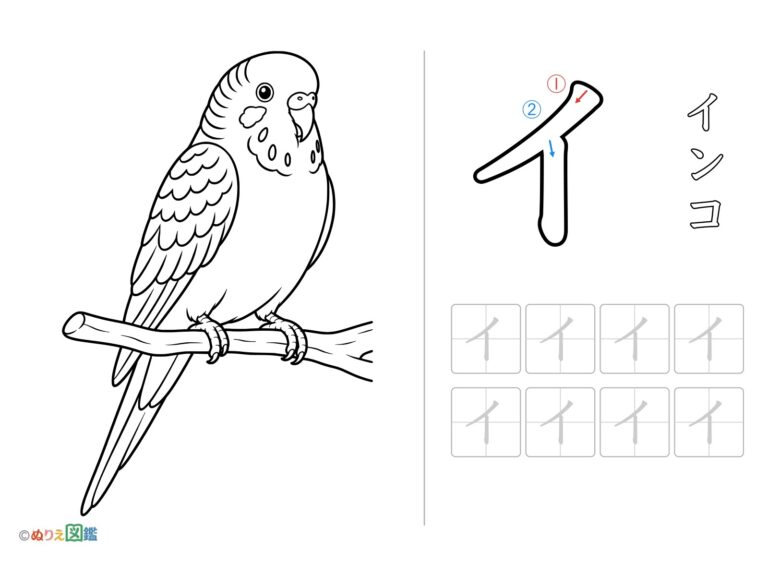
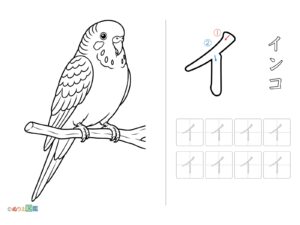
The word for this coloring page is "Parakeet" (Inko). It is a small bird with colorful feathers.
On the left side, I drew one budgie sitting on a tree branch.
Look closely at the two feet holding onto the branch and the patterns on its feathers.
Budgies are birds that many people keep at home as pets.
Katakana "I" Comes from the Kanji "伊"
Katakana letters were made by taking parts of kanji.
Katakana "I" came from the left side of the kanji "伊", the part called the person radical.
The person radical comes from the shape of a person. You can also find it in kanji like "休" and "体".
The hiragana "i" was made by simplifying the kanji "以", so their original kanji are different!
How to Write Katakana "I"
You write Katakana "I" in 2 strokes.
The first stroke is a line that smoothly sweeps down from top right to bottom left.
The second stroke starts near the middle of the first stroke. Bring it straight down and stop neatly at the end.
If you make the second line longer than the first line, your Katakana "I" will look strong and steady.
If the first line leans too low, it will look like a sideways "To", so watch the angle of your slant!
Words with Katakana "I"
Just like with "Parakeet", animal names are often written in katakana in picture books and guidebooks.
Words that start with Katakana "I" include dog (Inu), dolphin (Iruka), strawberry (Ichigo), ink (Inku), and chair (Isu).
You can write dog and dolphin in hiragana or kanji, too. But guidebooks usually use katakana.
We also use katakana for words from other countries like "ink", or sound words like "Eee!".
Try looking for Katakana "I" in books and on signs around you!
Compare Katakana and Hiragana
Try placing Katakana "I" next to hiragana "i".
You write hiragana "i" with two curved lines.
Katakana "I" also has 2 strokes, but its shape is straight and sharp.
Even though they make the same sound, hiragana looks soft and katakana looks neat and crisp.
Both hiragana and katakana were created in Japan. We write Japanese by mixing these two with kanji.
Using three types of letters is one of the fun things about the Japanese language!
How to Color Katakana "I"
Color the big Katakana "I" like a parakeet
Color the big Katakana "I" in any color you like.
If you use yellow-green or light blue like the parakeet's feathers, it will match the picture.
It is also a great idea to use different colors for the first stroke and the second stroke so you can check which one to write first.
Use bright colors for the parakeet
Wild budgies often have a yellow-green tummy and a yellow head.
Pet parakeets come in many colors, like light blue, white, and yellow.
For the wavy patterns on its back and wings, try tracing the lines with black or dark gray.
Color the beak light orange or cream color, and color the tree branch brown.
If you leave a little white space around the eyes, the face will look full of life.
Tips for tracing
Trace each Katakana "I" in the boxes on the bottom right using a pencil.
For the sweeping stroke in the first stroke, the trick is to relax your hand at the end to make it nice and thin.
For the second stroke, go straight down along the center line.
When you finish writing all 8, put a circle around the Katakana "I" you wrote best.
Finally, let's read the word
On the top right, next to the big Katakana "I", the word "INCO" (Parakeet) is written vertically.
When you finish coloring, trace it with your finger and read "INCO" out loud.
Connecting the picture, the letter, and the word makes it much easier to remember the letter.
When your coloring page is complete, you can tape it to the wall or keep it in a folder.
Fun Facts About Katakana "I"
Parrots are great at mimicking sounds
Budgies can sometimes copy human words and everyday sounds.
If you talk to them a lot, some budgies even learn words like "Good morning" or their own names.
Not every parrot can talk, but they will happily chirp to tell you how they feel!
Their home is Australia
Budgies are birds that originally live in the grasslands of Australia.
Wild budgies live together in big flocks and eat grass seeds.
The secret of their toes
A parrot has 4 toes on each foot, with 2 pointing forward and 2 pointing backward.
This special shape helps them hold tightly onto branches and grab their food.
Take a look at the parrot on your coloring page to see if it is holding tightly onto the branch!
The difference between parrots and cockatoos
Parrots and cockatoos belong to the same bird family.
Cockatoos have crown-like feathers on their heads, but budgies do not.
However, there are exceptions to their names! For example, the cockatiel has "parrot" in its Japanese name, but it is actually part of the cockatoo family.
Bird names are written in katakana like this, too!
Share These Katakana "I" Coloring Pages


-
Tracing the letter "I" (Parakeet)
-