Katakana "Byo" Coloring Pages


About Katakana "Byo"
The "Byo" in "Byoon"
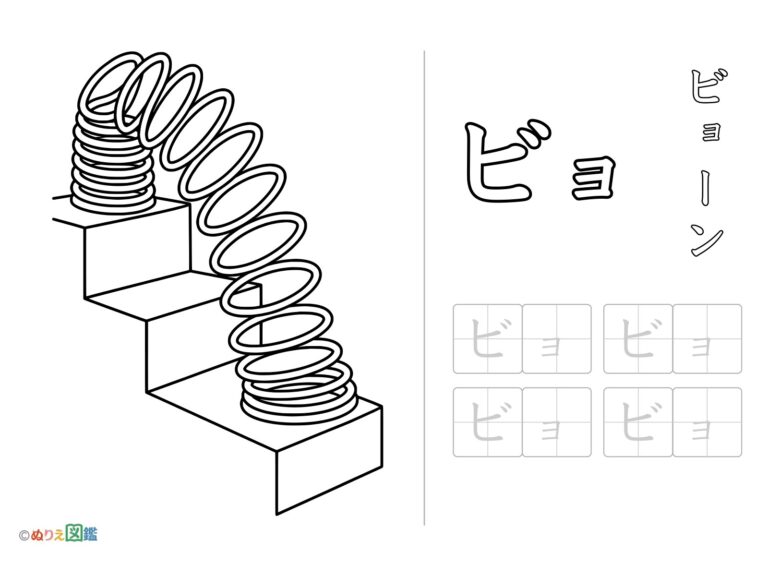
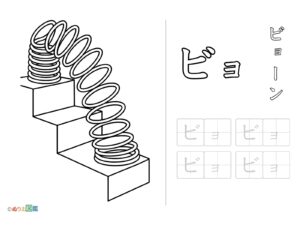
This coloring page is for practicing the Katakana "Byo".
The word is "Byon" (boing!). It is a word that shows how something stretches far or bounces up high with lots of energy.
On the left, there is a picture of a curly spring toy stretching long and going "boing!" down the stairs.
The spring goes down the stairs one step at a time, just like it is walking.
Two letters for one sound
Katakana "Byo" uses two letters, "ビ" and a small "ョ," to make one sound.
Letters made like this, with a small "ャ," "ュ," or "ョ" added to make one sound, are called youon.
When you say it out loud, try not to separate "ビ" and "ヨ." Say them together all at once! The "ー" in "ビョーン" is a mark that shows you to stretch out the sound before it.
How the character Katakana "Byo" came to be
Long ago, people made Katakana by taking one part of a Kanji or making its shape simpler.
"ビ" is the character "ヒ" with two small dots. These dots are also called dakuten.
The original character "ヒ" came from the right side of the Kanji "比".
The small "ョ" is just a smaller version of "ヨ". "ヨ" was made from a part of the Kanji "与".
While Hiragana came from flowing Kanji shapes, Katakana was made from pieces of Kanji, so it has lots of straight lines.
How to write Katakana "Byo"
Katakana "Byo" is made of 4 strokes in total: 2 strokes for "ヒ", plus 2 strokes for the little dots.
The 1st stroke of "ヒ" is a short line going sideways.
For the 2nd stroke, go down from the top, and then curve to the right.
For the dots, finish up by writing 2 short dots next to each other at the top right!
Small "ョ" has 3 strokes. For stroke 1, write a line that goes across and then turns down. For stroke 2, write the middle side-to-side line. For stroke 3, write the bottom side-to-side line.
If you leave about the same space between the 3 side-to-side lines, it will look super neat.
Write small letters so they take up about 1/4 of the box. When you write sideways, put it near the bottom left of the box. When you write top to bottom, put it near the top right of the box.
If you write "ョ" big, people will read it as two sounds, "BI-YO", so be careful!
Words with Katakana "Byo"
Besides words from other countries, Katakana is also used a lot to write sounds and describe actions.
"Byo~n" is one of those describing words!
Actually, there are very few Katakana words that start with "Byo".
In Hiragana, "byo" shows up a lot in Kanji words, like byoin (hospital), gabyo (thumbtack) for pinning paper to walls, or the byo for seconds in time.
It is also fun to stretch the sounds and compare saying "Byo~n" and "Biyo~n"!
How to Color Katakana "Byo"
Color the big Katakana "Byo" in your favorite colors
Try coloring the big Katakana "Byo" in the top right with any colors you like.
It is also fun to use rainbow colors like red, yellow, blue, and green, just like the spring toy.
To keep it neat, gently color along the outside lines first. Then, fill in the inside so you do not go out of the lines!
Color the spring in rainbow colors or silver
If you change the color for each loop, your spring toy will look super colorful like a rainbow!
If you want it to look like a real metal spring, color it gray and leave some parts white. It will shine just like silver!
Making the parts where the loops overlap a little darker shows how it winds around.
Use calm colors for the stairs
If you use calm colors like brown or light gray for the stairs, the colors on the spring will stand out.
If you color the top of the steps bright and the front a little darker, the stairs will look 3D.
Trace each pair with care
In the bottom right boxes, there are 4 pairs of light gray Katakana "Byo" words.
Use a dark pencil or a soft pencil to slowly trace over the light letters.
Use the center lines inside the boxes as a guide. This helps you see the size difference between big and small letters.
Saying the stroke order out loud as you write helps you remember it.
Write them to fit the box size so the spring does not stretch or shrink!
Fun Facts About Katakana "Byo"
Spring Toy Walking Down the Stairs
The spring toy that steps down the stairs one by one is a toy born in America.
When you put it on the top step and drop one end down to the next step, the weight of the spring makes it flip over to the next step.
It moves just like a living creature, so it became popular all over the world.
Springs are Super Helpful All Around Us
When you push a spring, it has a force that tries to go back to its original shape.
Springs are used in many things around us, like click ballpoint pens, mattress beds, and trampolines.
Try looking for springs inside your house, too!
"Byōn" and "Biyōn"
The way a spring stretches can be written as Byōn or Biyōn.
Using a small "yo" makes it one sound and gives it a fast feel, while using a big "yo" gives it a slow-stretching feel.
Changing just the size of a letter changes how it feels!
Let's Write it in Romaji
When you write Katakana "Byo" in Romaji, it becomes byo.
For sounds with a small "ya," "yu," or "yo," you use a y in Romaji.
You will learn Romaji in Japanese class around 3rd grade in elementary school.
It is also written on station names and road signs, so try to read it if you find it!
Share These Katakana "Byo" Coloring Pages


-
Tracing practice for "ビョ" (Byōnn)
-