Katakana "Sho" Coloring Pages


About Katakana "Sho"
"Sho" for "Excavator"
The letters on this coloring page are Katakana "Sho"Katakana "Sho"It is.
Words are"Excavator"It's Katakana "Sho"! The word starts with "Sho", doesn't it?
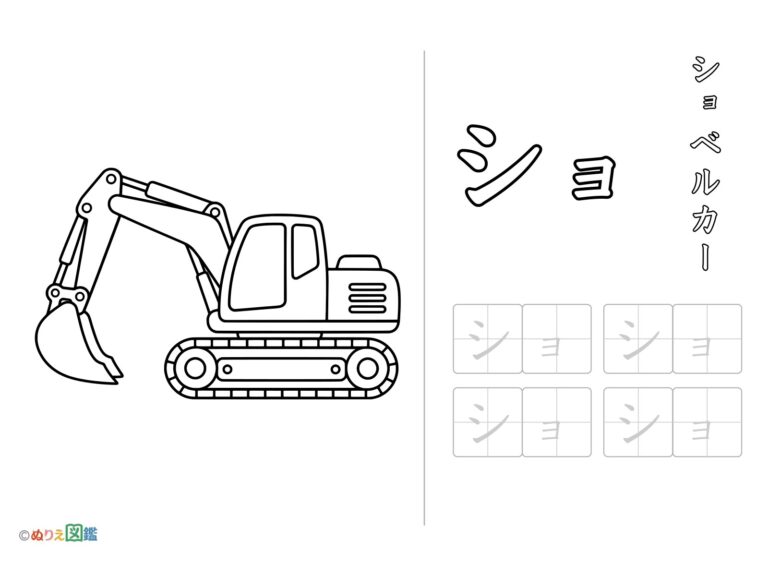
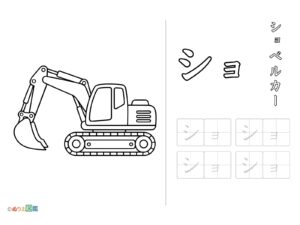
The picture on the left shows a power shovel facing sideways. It has a longArmAt the tip of it, scoop up the soilBuckethas a, and under the driver's seat, it can keep going even on bumpy roadsCaterpillar Tracksthere is.
It's a reliable working vehicle that plays a big part at construction sites by digging up and carrying dirt.
Katakana "Sho" isWords from other countriesYa,Names of animals and plants,Sounds and animal callsThis is a letter you often use when you write words like this. The word "shovel car" comes from a foreign language, too.
"Shi" and a small "yo" make one single sound
"Sho" in Katakana is written after "Shi,"Small "Sho"It is a character you write with a small symbol attached.
It is written with two characters, but you read it as "Sho"One soundbecomes this sound. A sound like thisContracted SoundsIt is called...
If you write "ョ" big to make it "シヨ", it turns into two different sounds: "シ" and "ヨ". Writing it small or big changes how you read it!
Try clapping your hands while saying "Shovel car." At the "Sho" part,Clap your hands onceAll you have to do is tap it.
The Kanji That Formed Katakana "Sho"
Katakana isPart of a KanjiThese characters were made by taking parts of Chinese characters or using the shapes of Chinese characters as a base.
It is said that long ago, Buddhist monks started using them to quickly write down how to read kanji characters in scripture!
"Katakana "Sho"" was made from the kanji "之".
Small Katakana "Sho" comes from a smaller version of big "Yo," and "Yo" was made from the kanji character "与."
Tips for writing Katakana "Sho"
"Sho" in Katakana is3 strokesIt's Katakana "Sho"!
Draw the 1st stroke and 2nd stroke on the left sideStack them top and bottomThis is a short dot that you write.
The third stroke isFrom the bottom left to the top rightSweep the stroke smoothly upward as you go across.
The similar character "ツ" has its dots lined up side by side, and the 3rd stroke isFrom top to bottomIt's a written character. Watch the way the dots line up and the direction of the last line of Katakana "Sho".
The small "Sho" has the same stroke order as the big "Yo", and3 strokesIt is.
When writing horizontally,bottom left of the boxLet's write it small! Be careful not to make it the same size as "Shi".
Words that start with Katakana "Sho"
Words that start with "Sho" include a deliciousStrawberry Shortcake, go shoppingShopping, a fun performanceKatakana "Sho"and more!
Spicy little bites that go with sushiGingerIt is also "Sho". Since it is the name of a plant, it is often written in Katakana in a Nurie Zukan.
Try saying words that start with "Sho" one after another, just like in a word chain game!
How to Color Katakana "Sho"
For the big Katakana "Sho", use different colors for the two letters
The big Katakana "Sho" at the top right is a letter with outlines for you to color inside.
If you color the big "シ" and the small "ョ" in different colors, it is easy to see that it is made of two letters.
If you color "シ" in yellow like the construction vehicles you often see, and the small "ョ" in orange or black, it will look just like a working vehicle!
It is also fun to change colors for each line, like the 1st stroke and 2nd stroke of the stroke order.
Color the body yellow and the tracks black
If you color the excavator's body and arm in yellow or orange, it will look like the colors you often see at construction sites.
Color the tracks in black or dark gray. If you color the wheel parts in gray, you can tell them apart from the tracks.
Color the teeth at the end of the bucket in silver or gray.
If you color the cab window in light blue and leave a little bit of white line, the glass will look shiny and bright!
The tracing practice comes in pairs of two
In the boxes at the bottom right, there are 4 pairs of light gray Katakana "Sho". There is a "シ" in the left box and a small "ョ" in the right box.
Hold your pencil correctly and trace slowly over the gray lines so you do not go outside them.
Use the vertical and horizontal center lines inside the boxes as a guide to easily learn the position and size of the letters.
Check to see if the small "ョ" fits nicely in the bottom left of its box too.
Every time you trace a pair, say Katakana "Sho" out loud, and you can learn the letter and its sound together!
Fun Facts About Katakana "Sho"
Words born in Japan
The word "shovel car" is a word made in Japan by combining the English words "shovel" and "car."
In English-speaking countries, people usually call a shovel car an "excavator."
Some Katakana words were created in Japan like this!
The bucket can be changed
Many Katakana "Sho" can change the tools on the end of their arms to match their job.
Besides the bucket that scoops up dirt, they can switch to tools that break hard concrete or tools that grab things.
Just one Katakana "Sho" is a hard worker that can do many different jobs!
The secret of the tracks
Crawler tracks work by moving forward on wide belts that press against the ground.
Because the wide surface holds up the heavy body, Katakana "Sho" does not easily sink, even on soft dirt or mud.
That is why Katakana "Sho" can keep moving forward, even at construction sites without any roads!
Let's compare it with the Hiragana "sho"
If you write Katakana "Sho" in Hiragana, it is "sho."
Actually, both the Hiragana "shi" and the Katakana "shi" came from the same Kanji, "之."
Hiragana was made by smoothing out the whole Kanji shape, while Katakana was made using a part or the main shape of the Kanji. That is why their shapes are different, even though they came from the same Kanji!
The small "yo" in Hiragana and Katakana both came from the Kanji "与," so they are like brothers and sisters!
Share These Katakana "Sho" Coloring Pages


-
"Sho" Tracing (Excavator)
-