Styracosaurus Coloring Pages
 ~

About Styracosaurus
A Frill Full of Spikes
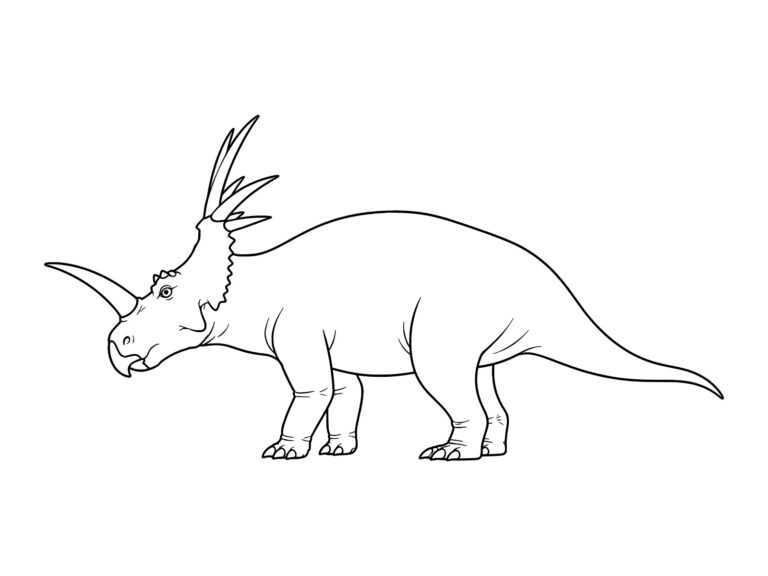
Styracosaurus is a horned dinosaur with a large frill behind its head.
Its name means "spiked lizard."
Four to six long spikes stick out backward and upward from the edge of its frill.
The longest spikes were even more than 50 centimeters long!
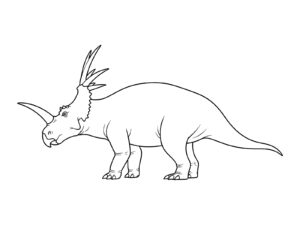
In the first coloring page, six long spikes spread out just like a king's crown.
A Long Horn on Its Nose
Another big clue is the one long horn reaching straight up from its nose.
Scientists think it was nearly 60 centimeters long!
On the other hand, the horns above its eyes were very small and shaped like little bumps.
Triceratops is in the same horned dinosaur family, but its long horns were above its eyes, so their long horns are in opposite places!
The tip of its mouth was sharp like a parrot's beak, which it used to pick and eat plants.
It Lived Along the Rivers of Canada
Styracosaurus lived in the Late Cretaceous period, about 75 million years ago.
Its fossils were found in 1913 near the Red Deer River in Alberta, Canada, North America.
That area is now called "Dinosaur Provincial Park," a place where many dinosaur fossils are found.
Its body was about 5 to 5.5 meters long, and scientists think it weighed over 2 tons.
Two Crossing a River
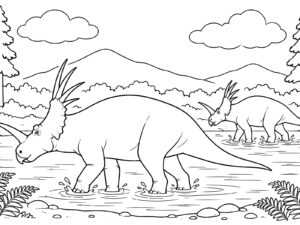
The second coloring page shows two Styracosaurus crossing a shallow river.
There is a big one in the front, and a slightly smaller one behind it on the right. Both are walking to the left.
Waves and water splashes are making bubbles around their feet.
You can see ferns and pebbles on the near bank, tall pine trees on the left and right, bushes on the opposite bank, and two mountains behind them.
Compare the Two Coloring Pages
The first page shows the full body of Styracosaurus from the side.
You can take your time counting the spikes on its frill or checking how long its nose horn is.
On the second page, as the two walk through the water, the tips of their feet are hidden underwater.
Even with the same dinosaur, adding scenery helps you imagine how it lived!
It is also fun to put it next to the coloring page of Pachycephalosaurus, which lived in the same Late Cretaceous period.
How to Color Styracosaurus
Color the Spikes Darker at the Tips, One by One
The best part of Styracosaurus is its frill spikes.
If you color each spike lightly at the base and darker toward the tip, they will look super sharp!
Changing the color between the main part of the frill and the spikes makes the shape of the spikes stand out.
Let's Add Patterns to the Frill
The frill is a big space, so it is perfect for making up your own patterns to color.
Try adding stripes of color along the edge, or draw round patterns that look like eyes.
Nobody knows what real dinosaurs looked like, so you can color them any way you want!
If you use cream color or gray for the nose horn and beak, they will look hard like real bone.
Give the Two Styracosaurus Different Colors and Patterns
On the second page, if you color the two Styracosaurus with different colors and patterns, it is fun because they look like a parent and child or brothers and sisters!
If you make the one in the back a little lighter, it will look like it is standing far away.
For the one in front, color its frill spikes with the darkest color to make it stand out like the main star.
If you use the same color for the spikes on both Styracosaurus, it will be easy to tell that they are friends.
Use the Wave Lines to Make Water
Color the river light blue or blue, and leave the paper white around the wave lines to make the water look shiny.
Leave the splashes white, or color them very light blue, too.
Color the ferns and pine trees green, the bushes on the other side light green, the mountains light purple, and the sky light blue to complete your Cretaceous riverbank!
Fun Facts About Styracosaurus
Every Styracosaurus Has a Different Number of Spikes
The spikes on the frill of a Styracosaurus were a little different in number and shape for each individual.
It is thought that some had 4 long spikes, while others had 6.
Just like how human faces are all different, they might have recognized their friends by their spikes!
Did They Live in Herds?
There are places where bones from many Styracosaurus are found together.
These places are called "bone beds."
In 2009, a Styracosaurus bone bed was dug up at Dinosaur Provincial Park in Canada.
Because of this, scientists think that they moved around in herds.
They might have lost their lives together in a flood or a drought.
What Were the Spikes For?
It is thought that the spikes on their frill were used not only to protect themselves from enemies, but also to show off to their friends.
Big, impressive spikes might have been a sign of strength.
Scientists are still studying to find out how they were really used!
Share These Styracosaurus Coloring Pages


More Cretaceous Period Coloring Pages
-
Styracosaurus Alone
-
Styracosaurus crossing a river
-
-