Ptarmigan Coloring Pages
 ~

About Ptarmigan
A bird that lives only on high Japanese mountains
The Ptarmigan is a bird that lives only on high mountains around the middle of Honshu.
It lives high up on mountains where big trees cannot grow, like the Northern Alps, Southern Alps, Mount Norikura, Mount Ontake, and Mount Hiuchi.
Birds in the Ptarmigan family live widely across cold northern countries. The Japanese Ptarmigan belongs to the group that lives the farthest south.
It is about the size of a small chicken, with a plump, round body.
It is thought that there are only about 2,000 of them in Japan. It is a Special National Natural Monument and a bird that is in danger of dying out.
Pure white in winter, brown and black in summer
The Ptarmigan is a bird whose feather colors change with the seasons.
The feathers on top of its body grow back three times a year. Each time, they turn colors that melt right into the view around it.
In winter, except for its tail feathers, it is pure white! You can barely tell where it is in the snow.
When summer comes, males turn blackish, and females get a spotted pattern of brown and black. They look just like the color of rocks and soil!
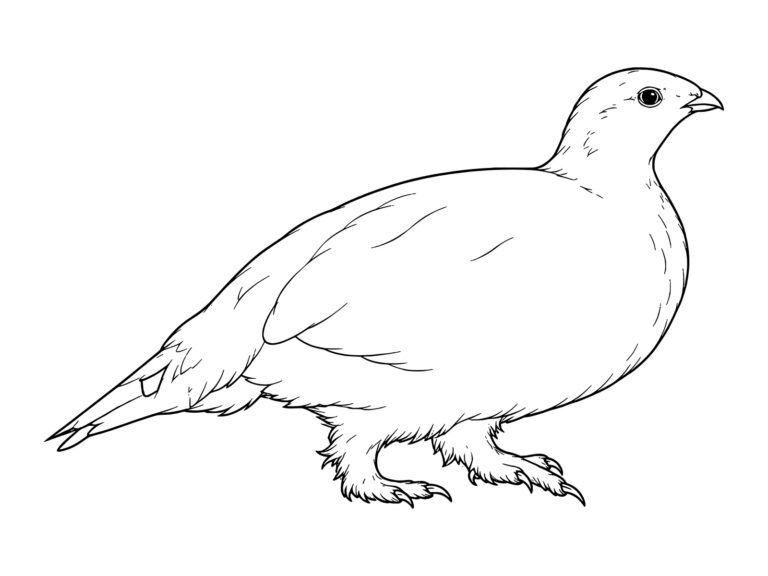
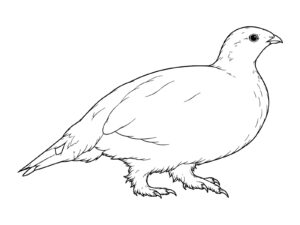
In the first coloring page, you can see a female with winter feathers walking on the snow.
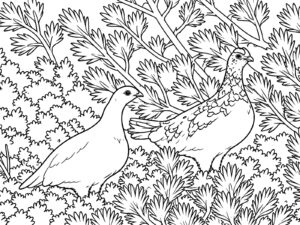
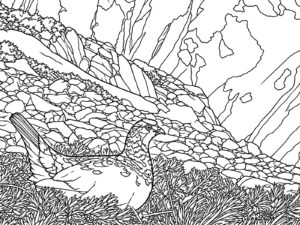
On the second and third pages, the males have black spots mixed into their white bodies.
This is how they look in spring, when their winter white feathers are changing into summer feathers.
On the second page, the female is still pure white, but the male next to her is already spotted!
Another high-mountain animal that turns white in winter is the stoat.
Fluffy feathers all the way to the tips of its toes
Let's look at the Ptarmigan's feet in the first coloring page.
The Ptarmigan's feet are covered in white feathers all the way to the tips of its toes.
People say these feathers keep its feet warm in cold winters and make it easier to walk on snow.
Peeking out from between the feathers are its claws, which help it grip the snow tightly.
Siberian dwarf pine bushes are an important home
In the second coloring page, the plants spreading behind the male and female are Siberian dwarf pines.
Siberian dwarf pines are short pine trees that grow on high mountains. Their branches stretch out as if crawling along the ground.
The Ptarmigan builds its nest and lays eggs under these pine bushes.
It also hides in the pine bushes or among rocks so foxes, crows, and falcons will not find it.
Usually, it eats leaves, buds, and seeds of mountain plants, as well as insects.
The red crest above its eyes
The males on the second and third coloring pages have a red crest above their eyes.
This red crest stands out especially on the males.
When spring comes, the male watches over its territory on rocky spots and pairs up with a female.
The third page shows a male standing with its tail straight up on a rocky spot on a snowy high mountain.
Behind it, you can see a slope with small pebbles, as well as snowy valleys and mountain ridges.
If you see one, watch it gently
People say that the Japanese Ptarmigan is not very afraid of humans.
Even if you can see it up close, you must not get too close or chase it.
If you meet one on a mountain trail, stop walking, stay at least 5 meters away, and watch it quietly.
Do not make loud noises or surround it, either.
Never give it treats or drop food trash.
Food trash brings foxes and crows up to the high mountains, and they hunt the Ptarmigan.
Touching or catching a Ptarmigan is banned by law.
How to Color Ptarmigan
Leave the white feathers uncolored and add shadows
For the winter Ptarmigan in the first picture, use the white paper as the feather color.
Add just a little shadow using light blue or light gray under the belly, at the base of the neck, and where the wings and tail meet.
This makes the pure white body look soft and round.
For the feathers on the feet, gently put shadows along the edges to make them look fluffy.
Color the black parts like the eyes, beak, claws, and the tip of the tail with black or dark gray.
Tips to tell the white snow and white bird apart
You can leave most of the snowy ground white, too.
Lightly brush light blue only around the Ptarmigan's feet and in the hollows of the snow.
Lightly layer light gray and light blue for the blurry background to make it look like a snowy mountain.
The best tip is to add a little snow shadow right outside the bird's outline.
When you do this, the white body will stand out clearly against the snow.
Spotted patterns and the red crest
For the males in the second and third pictures, color the black spots on the head, neck, and back with dark gray or black.
Each spot has a different shape, so color them carefully inside the lines.
If you leave the white parts, you can clearly see how the feathers change from winter to summer.
Color the crest above the eyes with a bright red to make it really pop!
Leave the female in the second picture white, and compare how she looks different from the male.
Use colors of high mountains for the Siberian dwarf pine and rocks
Color the leaves of the Siberian dwarf pine with a bluish dark green.
Mix in some yellow-green and brown here and there to make it look like a high mountain bush.
Color the pebbly slope in the third picture gray, the rocky mountain in the back dark gray, and leave the remaining snow white.
If you want to make it look like summer, you can color the body with brown and black spots.
It is also fun to color it alongside the Long-tailed Tit coloring page, which is another white bird.
Fun Facts About Ptarmigan
Ptarmigan Means "Thunder Bird" in Japanese
The Japanese name for Ptarmigan is written with characters that mean "Thunder Bird."
People say it got this name because Ptarmigans come outside even on stormy days when thunder rumbles.
However, no one knows the real reason for sure.
In the Edo period, people believed that Ptarmigans protected them from lightning and fires.
Messengers of the Mountain Gods
In Japan, high mountains have long been loved as special places for the gods. People thought Ptarmigans were messengers of these mountain gods.
Because of this, they are sometimes called "God's Birds."
Some people think Ptarmigans in Japan are not afraid of humans because people have cared for them for a long time.
Today, the Ptarmigan is the prefectural bird of Nagano, Gifu, and Toyama.
Ptarmigans Came Back to the Central Alps
About 50 years ago, Ptarmigans disappeared from the Central Alps.
But in 2018, people found one female Ptarmigan there.
So, the Ministry of the Environment started a rescue project. They moved Ptarmigan families from other mountains and released Ptarmigans raised in zoos back into the wild.
When chicks are small, people put them in cages to protect them from enemies and bad weather.
Thanks to these efforts, the number of Ptarmigans in the Central Alps grew to about 300 by 2025.
Share These Ptarmigan Coloring Pages


More Birds Coloring Pages
-
Winter white ptarmigan
-
Male and female Japanese stone pine near a dwarf stone pine
-
-
Male in snow-covered rocks
-
-