Koi Coloring Pages
 ~

About Koi
Colorful Koi Born in Japan
The Nishikigoi is a Koi with colorful patterns like red, white, black, and yellow.
"Nishiki" means a beautiful cloth woven with colorful threads.
People say the Nishikigoi was born in a mountain village in Niigata Prefecture.
It all started when a colorful fish was born among the dark Magoi that people raised for food.
As people chose and raised those special fish, many different patterns of Nishikigoi were created.
Now, there are more than 100 kinds, and they are popular all over the world as "swimming jewels."
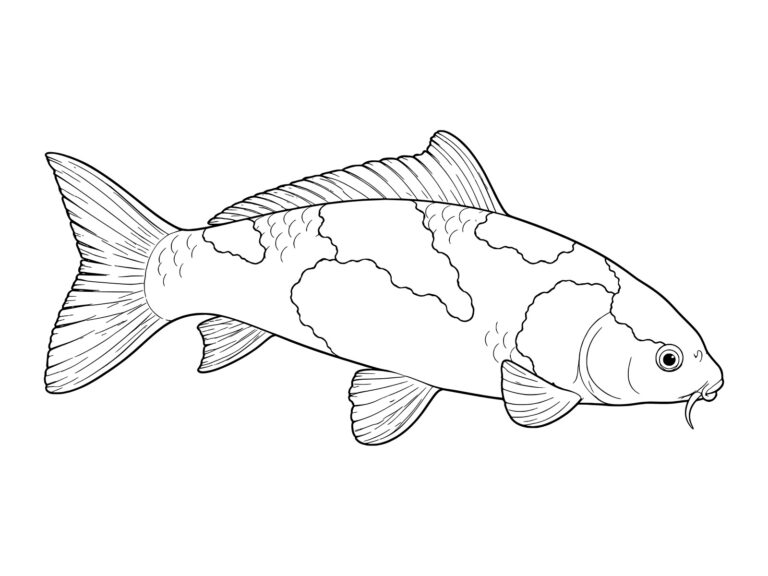
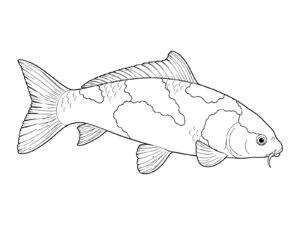
A Koi seen from the side
The first coloring page shows a Nishikigoi from right next to it.
It has a sturdy body and a long back fin that stretches from the middle of its back all the way near its tail, right?
At the tip of its mouth, you can see its whiskers, which are the mark of a Koi.
Let's check where all the fins are, like the chest fins, belly fins, bottom fin, and the split tail fin!
Looking from above is how to enjoy Nishikigoi
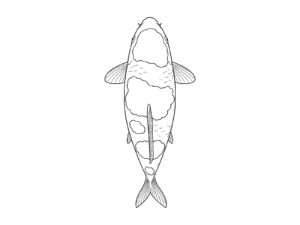
The second coloring page shows the same red and white Nishikigoi seen from right above.
Nishikigoi are fish that people enjoy looking at from above in a pond, so the patterns on their backs are the most important part.
The Koi in this coloring page is a variety called Kohaku.
On its white body, red patterns line up from its head to its tail.
Take a look at the pectoral fins spreading to the left and right, the dorsal fin in the middle of its back, and the split tail fin, too.
Kohaku is the most basic variety among Nishikigoi. Together with Taisho Sanshoku and Showa Sanshoku, they are called the "Big Three."
Sometimes, people compare how great a Koi is by the shape and balance of the red pattern on its head.
Koi Swimming in a Water Lily Pond
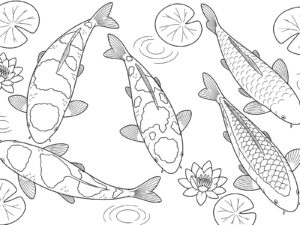
The third page is a view of the pond from directly above.
Five Nishikigoi are swimming peacefully between the round leaves and flowers of water lilies.
Each Koi is different, like Koi with patterns, Koi without patterns, and Koi with clear scale markings.
They are swimming with their bodies slightly bent, so try to imagine which way they are going.
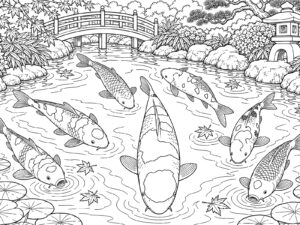
Japanese garden pond
The fourth one is a Japanese garden pond.
In the back, you can see a bridge over the pond, a stone lantern, a pine tree, and round trimmed bushes.
Lots of Koi are swimming in the pond, and a few of them have their mouths out of the water.
Water lily leaves and fallen maple leaves are floating on the water.
You might have seen Koi swimming in a pond at a Japanese garden or a temple before.
How to Color Koi
For Kohaku, Make the Red and White Stand Out
For Kohaku in the 1st and 2nd pictures, color the red patterns with bright red or orange.
If you leave the white parts uncolored, your Koi will look nice and neat, just like a real Kohaku.
The trick is to color neatly along the lines where the red and white meet.
If you make the fins white or light blue, they will look see-through!
Try Coloring Different Varieties
For the 3rd and 4th pictures, pick a variety for each Koi before you color.
・Kohaku: A white body with red patterns
・Taisho Sanshoku: Kohaku with small black spots
・Showa Sanshoku: A black body with red and white patterns
・Ogon: The whole body is gold or yellow
・Asagi: A bluish-gray back with dark scale patterns
No two Koi have the same pattern, so you can even make up your own special variety!
Pond Water and the View Around It
Color the pond water with greenish-blue or light blue.
If you make the color a little lighter around the Koi, it will look like the Koi is glowing in the water.
Color the lily pads green, the flowers pink or white, and the maple leaves red or orange.
If you leave the ripples on the water white, you can really tell the Koi is popping its mouth out!
If you color the bridge in the 4th picture red, it will look like a fancy Japanese garden.
You can also try making an autumn garden by matching it with the Japanese Maple autumn maple leaf coloring page!
Fun Facts About Koi
It All Started in a Mountain Village in Niigata
It is said that Koi were first bred during the Edo period around what is now Ojiya City and Nagaoka City in Niigata Prefecture.
In these mountain villages with heavy snow, people raised carp to eat during the winter.
When colorful carp were born among them, the villagers raised them with great care, and that is how Koi were created.
Even today, this area is known all over the world as the home of Koi.
Koi Have Barbels (Whiskers)
If you look closely around the mouth of the Koi viewed from the side in the first picture, you will see barbels.
Koi have two pairs of barbels around their mouth, which means four in total.
It is said that they use these barbels to look for food at the bottom of the water.
Goldfish, which look very similar, do not have barbels.
The Koi of the Koinobori Streamers
The Koinobori (carp streamers) that people display for Children's Day in May are also shaped like Koi.
Koi are seen as strong fish that can swim up fast-flowing rivers, so they carry a wish for children to grow up healthy and strong.
Compare the Koi in a pond with the Koi on the carp streamers, and try to find their barbels and fins!
Share These Koi Coloring Pages


More Fish Coloring Pages
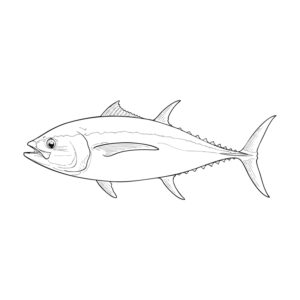
-
Red and white carp viewed from the side
-
Red and white koi from above
-
-
Nishikigoi in a water lily pond
-
Japanese garden pond
-
-