Japanese horse mackerel Coloring Pages
 ~
~ 
About Japanese horse mackerel
A popular fish at the Japanese dinner table
Japanese horse mackerel is a fish that is very close to us. Many of them live in the seas around Japan.
The fish usually called "aji" is a type named Japanese horse mackerel, and it is about 20 to 30 centimeters long.
It is eaten in many dishes like fried Japanese horse mackerel, dried fish, and sashimi.
Its tasty season is early summer, around May to July.
It is caught all year round, so you can see it almost every day at the supermarket.
The body secret: "Zeigo"
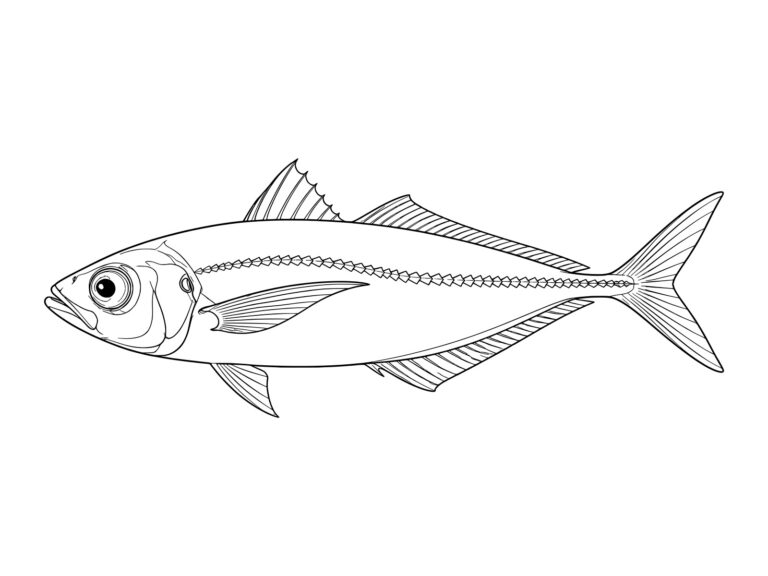
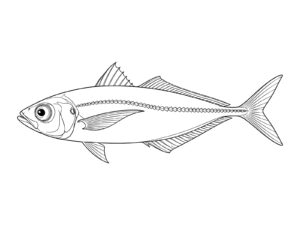
The main feature of Japanese horse mackerel is the "zeigo" lined up along the side of its body.
Zeigo are small, hard, spiky scales connected like a chain.
They line up all the way from behind the gills to the base of the tail fin.
It feels rough when you touch it, so people scrape it off with a knife when cooking.
In the first coloring page, trace with your finger to see where the zeigo starts and ends!
Find these features too
There is one small black spot near the top behind the gill cover.
There are two dorsal fins, and the front one is sharp like a triangle.
The tail fin is forked deeply into two parts. Many fast-swimming fish have this shape.
Try comparing its shape with the coloring pages for mackerel and bonito, which also swim fast!
Two coloring pages
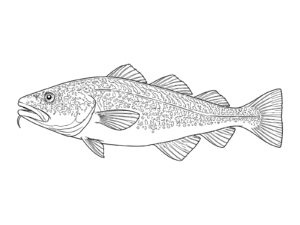
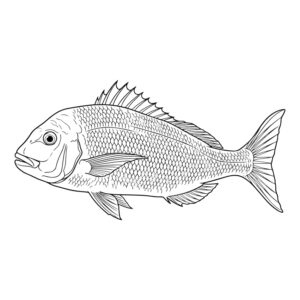
The first picture shows one Japanese horse mackerel from the side, based on a photo.
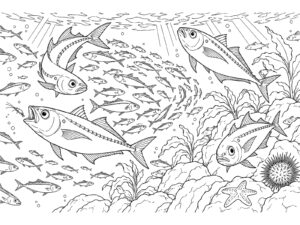
The second picture shows a school of Japanese horse mackerel swimming in a swirl around a rocky spot in a bright, shallow sea.
You can see one opening its mouth to catch a small shrimp, one twisting its body to turn, and one looking at you near a rock.
Try to find the sea urchin and starfish on the rock too!
Many ways to eat Japanese horse mackerel
There are so many ways to eat Japanese horse mackerel, such as grilled with salt, fried, pickled in sweet and sour sauce, dried, and as sashimi.
"Namerou", made by chopping it finely and mixing it with miso and green onions, is a dish created by fishermen in Chiba Prefecture.
When Japanese horse mackerel is small, it is called "ko-aji," and when it grows big, it is called "oo-aji." Small ones taste great when deep-fried whole!
There is also a coloring page for salted grilled Pacific saury, an autumn fish, so enjoy coloring that one too!
How to Color Japanese horse mackerel
Back is blue-green, belly is silver
Color the Japanese horse mackerel's back in blue-green or yellow-green.
Make the belly silver or light gray, and leave some white spots to make the body look shiny and bright!
Try to blend the blue-green lightly where the back meets the belly.
The scutes are yellowish
If you color the scutes in light yellow or ocher, you can see a neat line along the side of its body.
Real Japanese horse mackerel can look a bit golden when the light hits them.
If you have a gold colored pencil, try adding a little bit around the scutes.
Fins and eyes
Color the fins in light yellow or light gray so they look see-through.
For the eyes, color around the pupils in light gray and leave the shiny part white.
Color the small black spot behind the gill cover in dark gray or black to make it look just like a real Japanese horse mackerel!
The sea in page 2 is bright blue
Color the sea on the 2nd page in light blue or bright blue to make a shallow sea where sunlight reaches.
Leave the sunbeams coming from the water surface white, or put a little light yellow on them.
Make the rocks gray or brown, the seaweed brown or ocher, the sea urchin purple, and the starfish orange to create a busy sea!
Change the color for each fish in the school
For the Japanese horse mackerel in the front of the 2nd page, try changing the color of each back a little, using blue-green, yellow-green, and golden yellow.
If you color the small Japanese horse mackerel in the back in light water-blue mixed with the sea color around them, they will look like they are swimming far away!
Fun Facts About Japanese horse mackerel
Is its name from being "tasty"?
One story says that the Japanese horse mackerel got its Japanese name, "Aji," because "it tastes good" ("aji ga yoi").
A scholar from the Edo period wrote that down in his books.
It shows just how much people have loved eating this tasty fish for a very long time!
"Yellow Japanese horse mackerel" and "Black Japanese horse mackerel"
There are two types of Japanese horse mackerel: the "Yellow Japanese horse mackerel" that lives around rocks, and the "Black Japanese horse mackerel" that swims across the wide ocean.
Yellow Japanese horse mackerel have yellowish bodies and are full of good fat.
Some Japanese horse mackerel are famous for where they are caught, like the "Seki-aji" from Oita Prefecture!
The "Tai no Tai" inside a Japanese horse mackerel
Inside a fish, there is a special bone called the "Tai no Tai," which is shaped just like a fish!
Japanese horse mackerel have this bone too. Look for it after you eat, and you might find a tiny fish-shaped bone.
People say it brings you good luck if you find one!
Fish that live in schools
Japanese horse mackerel swim together in large schools with lots of friends.
Swimming in a big group makes it harder for bigger fish to hunt them.
Fish with "zeigo" and fish without
Many fish in the Japanese horse mackerel family have hard, scaly ridges called "zeigo" on their sides.
But some family members, like the Japanese amberjack and the greater amberjack, hardly have any zeigo at all!
Share These Japanese horse mackerel Coloring Pages


-
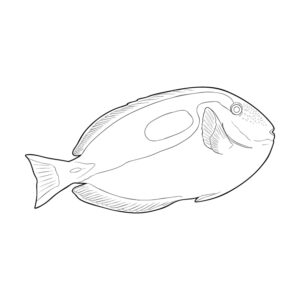
Japanese Horse Mackerel (from the side)
-
A school of horse mackerel swimming around the rocks
-