Porcupinefish Coloring Pages
 ~

About Porcupinefish
A relative of the pufferfish with prickles all over its body
Porcupinefish areTiger pufferfishSame asRelatives of the PorcupinefishIt's a fish.
all over its body,Long spineshave lots of spines growing on them.
Usually, the Porcupinefish keeps its spines laid down facing backward, flat against its body.
It has cute big round eyes and a small mouth, doesn't it?
Inside its mouth, on the top and bottomA hard, beak-like toothand they crunch up and eat hard things like shells, crabs, and sea urchins.
In Japan, you can find them in rocky areas and coral reefs in warm seas.
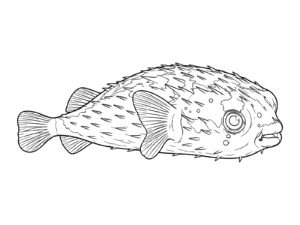
Porcupinefish when it is normal
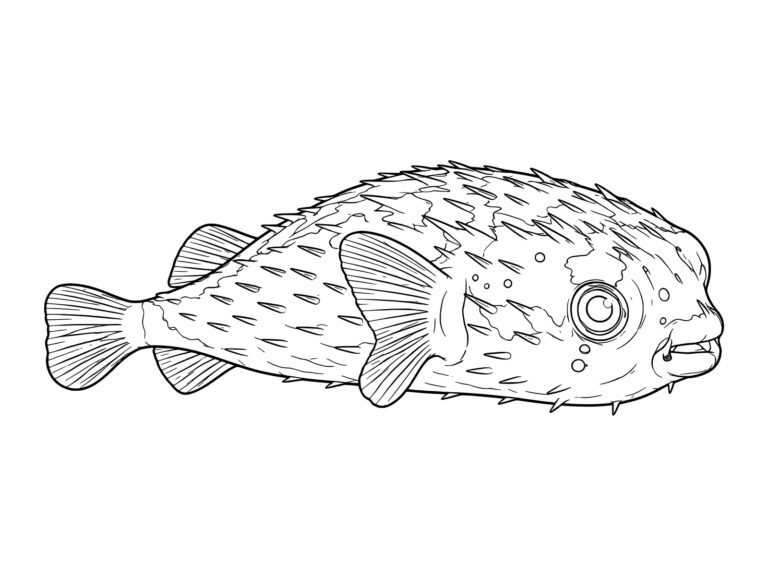
The first coloring page isA Porcupinefish when it is not puffed upThis is what a Porcupinefish looks like from the side!
It has a chubby body and big chest fins that look like folding fans!
Its dorsal fin and anal fin are small and set near the back of its body, and its caudal fin is round.
The body has dark brown spots scattered all over it, doesn't it?
Porcupinefish move their fins quickly to swim slowly and softly.
When it puffs up, it becomes a round ball
Porcupines fill their bodies with water or air and puff up like a round balloon when they think an enemy might attack them!Gulp down lots of waterI puff up my body.
Then, its body turns into a round ball, and its flat spinesThey all stand up straight at onceIt is.
A ball full of prickles is really hard for even a big fish to swallow, isn't it?
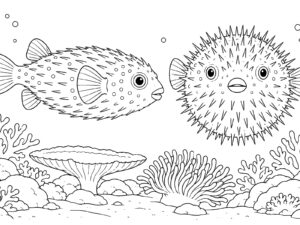
On the second coloring page, you can see a normal Porcupinefish on the left, and on the right,A Porcupinefish puffed up into a round ballHere is a Porcupinefish!
When you compare the two, you can really see how much their shape changes when they puff up.
Puffing up takes a lot of energy for them, so they only do it when they are really scared.
Living in the gaps of coral reefs
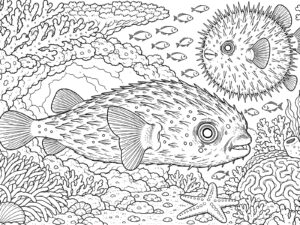
The third one is a livelyCoral reefsHere is the Porcupinefish inside the .
The Porcupinefish in the middle is in front of a hollow in the rock, looking right at you with its big eyes.
In the top right, a puffed-up Porcupinefish is floating.
Around it, you can see all kinds of shapes of coral, sea anemones, starfish, seashells, and a school of small fish, can't you?
Porcupinefish stay still in rock crevices during the day, andMoves around at nightIt is said that this happens often.
How to Color Porcupinefish
Make the body dark on the back and white on the tummy
The Porcupinefish's body is ochre or brown on its back and whitish on its tummy.
If you color it so it gets lighter from its back to its tummy, its body will look nice and plump.
For the spots, color them one by one with a tiny dab of dark brown or black.
It has big eyes, so if you leave a white shiny spot inside the dark center, it will look super cute!
If you color around the dark center with yellow or yellow-green, it will give the Porcupinefish its signature sparkly eyes.
The trick with spines is not to color them too much
For the spines, keep them a slightly lighter color than the body, or leave them white.
If you color all the spines with dark colors, the body will look messy.
When the Porcupinefish puffs up, color the edge of the ball a bit darker and the middle lighter to make it look round and puffed out.
If you put just a little bit of dark color at the base of each spine, they will really look like they are standing up!
Make a colorful coral reef
You can color the coral in any color you like, such as pink, purple, yellow, or orange.
The Porcupinefish is brownish, so if you make the coral around it bright, the Porcupinefish will really stand out.
For the water, use light blue. Make it bright at the top and a little darker at the bottom to show how deep the sea is.
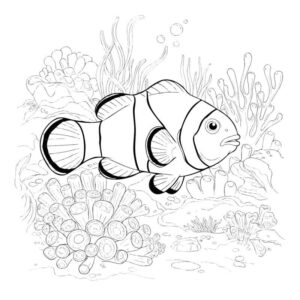
Try coloring this together with the Clown Anemonefish coloring page, another fish from the same coral reef, or the Coral Reef of Ishigaki Island coloring page!
Fun Facts About Porcupinefish
They do not have a thousand needles, but about 300
The Japanese name for Porcupinefish means having a thousand needles.
But the real number of needles is said to be about 300 to 400.
They do not have a thousand, but it is a great name for how prickly they look!
In English, they are called "Porcupinefish" because people compare them to a porcupine, an animal with sharp spines.
They are related to blowfish, but they are not poisonous
Many fish related to blowfish are poisonous, but Porcupinefish do not have poison like blowfish do.
In Okinawa, people call them "Abasaa" and eat them in miso soup.
However, their spines are very sharp, so make sure not to catch them or touch them in the ocean.
They drink water to puff up
Porcupinefish and blowfish make their stomachs big like a bag and fill them with water to puff up.
Sometimes they gulp in air and puff up when taken out of the water.
However, puffing up with air makes it hard to go back to normal, and it is said to be bad for their bodies.
At the aquarium, let's quietly watch them from behind the glass.
Share These Porcupinefish Coloring Pages


More Fish Coloring Pages
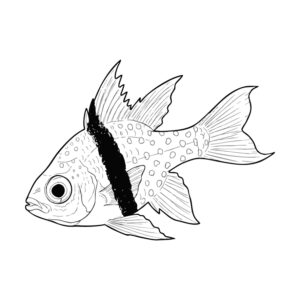
-
Porcupinefish
-
Before and after inflating
-
-
Porcupinefish in a coral reef
-
-