Sardine Coloring Pages
 ~
~ 
About Sardine
A Small Fish in the Japanese Sea
The Sardine is a small fish about 20 centimeters long that lives in big groups in the seas around Japan.
The fish usually called "Sardine" is a type called the Japanese pilchard.
Besides the Japanese pilchard, there are friends like the Japanese anchovy and the round herring.
They get fatty and tasty from June to October. Sardine caught during the rainy season is called "nyubai sardine" and is said to be extra delicious.
The "Seven Stars" on its Side
On the side of a Japanese pilchard, there are about 7 to 10 black spots lined up in a row.
Because it has these spots, people sometimes call this Sardine "nanatsuboshi" (seven stars).
Try counting how many spots there are on the first coloring page!
It has one fin on the middle of its back, and its tail fin splits deeply into two parts.
Its scales come off very easily, and they drop right off even if you just touch them.
Living in Big Groups
Sardine live together in big groups of thousands or even tens of thousands.
When big fish or seabirds attack them, Sardine huddle tightly together into a ball shape.
This is called a "bait ball."
Gathering in a big group makes it harder for enemies to pick out a single fish. It also tricks enemies by making the group look like one giant sea creature!
2 Coloring Pages
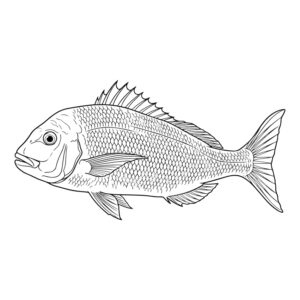
The first coloring page shows one Japanese pilchard from the side, based on a photo. You can clearly see the row of black spots on its side and the tiny scales on its back.
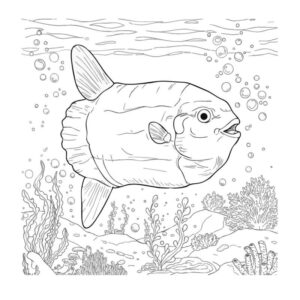
The second coloring page shows a scene where a huge group of Sardine makes a bait ball.
A bonito charges in from below, seabirds dive into the water from above, and a dolphin swims right next to them.
Inside the ball, you can see some Sardine quickly turning around, and others looking right at you!
Sardine at the Dinner Table
Sardine has been a popular fish on Japanese dinner tables for a long time.
You can eat it grilled with salt, simmered, deep-fried, or as fishballs. It is also made into dried fish and canned fish.
When cooked until the bones are soft, you can eat the whole fish, bones and all! This gives you lots of calcium to make your body strong.
Many are caught and they are cheap to buy. They are such an important fish that people have long called them the "rice of the sea."
How to Color Sardine
Blue back, silver belly
Color Sardine's back with dark blue or blue-green.
Color the belly silver or light gray, and leave a few white spots to make the body look shiny!
If you blend the blue so it softly fades where the back meets the belly, Sardine will look just like a real fish.
Draw the black dots clearly
Color the black dots on the side of the body carefully with dark gray or black.
Making the dots clear helps everyone know right away that this is a Japanese Sardine!
For the eyes, color around the pupils with light yellow, and leave the shiny spots white.
Scales on the back and the boundary line
The long line on the side of the body in the first picture is where the back color meets the silver belly.
If you color above the line with dark blue or blue-green and below the line with silver or white, it will look just like a real Sardine!
For the little scales on the back, add layers of dark color here and there to give them a shiny look.
Color the bait ball with blue shades
It is hard to color all the Sardine fish in the second picture one by one. You can color the whole ball with blue and silver first, and then carefully color just the big Sardine fish in the front!
Color the middle of the ball dark blue and the edges light blue to make the crowded group look round and real.
Bonito, seabirds, and dolphins
Color the bonito's back dark blue-purple, and color the stripes on its belly dark gray.
For the seabird, color its body white, its head light yellow, and the tips of its wings black to make it look like a booby!
Color the dolphin gray, and color the ocean light blue or blue.
Water surface and light rays
Color the water surface at the top of the second picture with light blue, and leave white lines along the waves.
Leave the sun rays shining down from the surface white, or color them light yellow to make the ocean look bright!
Leave the bubble trails white too after the seabird dives in.
Fun Facts About Sardine
Is the name from "weak"?
One story says that the name Sardine comes from "yowashi," an old word that means weak.
That is because they get weak right away when you take them out of the water.
Even in Japanese kanji, the word for "Sardine" is written with the character for "fish" and "weak."
Setsubun and Sardines
On Setsubun, there is a tradition to stick a grilled Sardine head on a holly branch and decorate the entrance of your home.
This is called "Hiiragi Iwashi."
People say the smell of the grilled Sardine and the sharp holly leaves chase away bad spirits!
A fish that supports sea life
Sardines are food for many creatures like bonito, tuna, dolphins, humpback whales, and seabirds.
These tiny Sardines support the lives of big ocean creatures!
Shirasu and Niboshi
The tiny white fish called shirasu that you put on your rice are baby Sardines.
The niboshi used to make soup stock for miso soup are dried boiled Sardines, too.
Fish that go up and down
The Japanese Sardine is a mysterious fish because the amount people catch goes way up and down every few decades.
People think changes in the sea temperature have something to do with it.
Share These Sardine Coloring Pages


-
Japanese pilchard (side view)

-
Sardine bait ball

-