Ohagi Coloring Pages
 ~
~ 
About Ohagi
Japanese Sweets Eaten During Autumn Higan
Ohagi is a Japanese sweet made from a mix of sticky rice and regular rice. The cooked rice is lightly mashed so half the rice grains stay whole, shaped into balls, and covered in sweet bean paste or soybean powder. For a long time in Japan, people have made this during Higan to offer to their ancestors. It is said that eating this during Higan became a set tradition back in the Edo period.
"Botamochi" in Spring, "Ohagi" in Autumn
Actually, Ohagi and Botamochi are almost the exact same food! They have different names because people name them after seasonal flowers. In spring, they are written as "牡丹餅" after the peony flower. In autumn, they are written as "お萩" after the bush clover flower. So even though they are the same thing, it is called Botamochi in spring and Ohagi in autumn.
Other Ideas About the Name Differences
Besides spring and autumn, there are other ideas about why the names are different. Some people say Botamochi uses smooth bean paste and Ohagi uses chunky bean paste. Others say Botamochi is mostly sticky rice, while Ohagi is mostly regular rice. Some even say Botamochi uses sweet bean paste and Ohagi uses soybean powder! Rather than one being right, it just changes by area and family.
Autumn Red Beans Have Soft Skins
Here is another fun idea! Red beans are harvested in autumn, and fresh red beans have soft skins. So you can make chunky bean paste right away. But by spring, the skins get hard, so people strain them to make smooth bean paste. That is why autumn Ohagi uses chunky bean paste, and spring Botamochi uses smooth bean paste!
Three Flavors: Sweet Bean Paste, Soybean Powder, and Sesame
There are a few types of Ohagi. The classic three are sweet bean paste, nutty soybean powder, and crunchy sesame! In some places, people even use green seaweed powder. The first coloring page shows these 3 types lined up, so try coloring each one in different colors!
Autumn Higan in 2026 Starts on September 20th
Higan lasts for 7 days in total, with Autumnal Equinox Day right in the middle. Since Autumnal Equinox Day in 2026 is September 23rd, Higan runs from September 20th to the 26th. Around this time, lots of Ohagi will line the shelves at Japanese sweet shops and supermarkets. When you visit family graves, it is nice to buy some Ohagi on your way home!
How to Color Ohagi
Color the 3 Ohagi in Clearly Different Colors
On the first page, three kinds of Ohagi are lined up. The left one is red bean paste, so try using a dark reddish-purple. The middle one is kinako, so a light yellowish-brown works best. The right one is sesame, so go with gray or a dark brown close to black. When you color these three clearly different, anyone can tell what each one is right away. If you use the same color for all of them, people won't be able to tell the three kinds apart!
Change the Shade for Each Red Bean Grain
The red bean paste Ohagi has many round azuki bean grains drawn on it. Instead of coloring them all the same, try changing the shade a little for neighboring grains to make them look nice and plump. If you leave the lines between the grains uncolored, each single grain will stand out clearly!
Kinako Looks Best When You Color It Lightly
The kinako Ohagi is the part of the picture with the fewest details drawn on it. For this part, just gently sweep a light yellowish-brown over it without pressing hard. If you color it too dark, it won't look soft and powdery like real kinako. If you make just the edges a little darker, it will look round and puffy!
Don't Use Too Much Color on the Tea and Steam
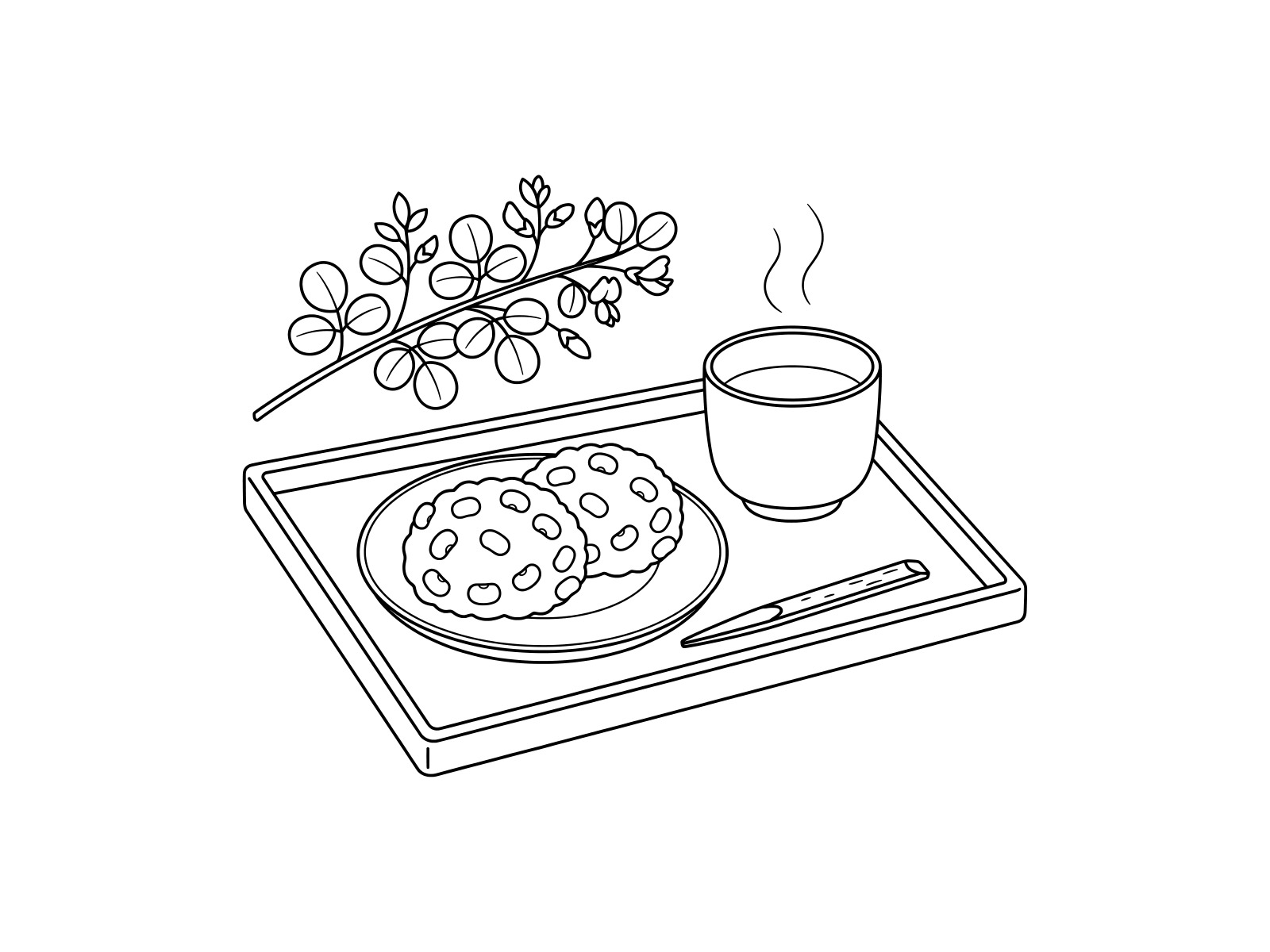
A teacup appears on the second and third pages. Color the tea a light yellow-green to make it look just like green tea! Leave the lines for the steam white without coloring them. The bush clover flowers on the third page are light reddish-purple, and the leaves are green. If you color the tiered box a reddish-brown or black, it will look neat and tidy, just like a real traditional Japanese box!
Fun Facts About Ohagi
The red of azuki beans keeps bad luck away
Why do we use azuki beans for Ohigan? Actually, people in Japan have long believed that the red color of azuki beans has the power to ward off bad luck. That is why azuki beans are often used in foods for seasonal events, like Setsubun and celebrations. Offering Ohagi also includes a wish to keep you safe from harm.
Sugar used to be very rare
Today you can buy sugar anywhere, but it used to be a very rare thing in old Japan. Ohagi, made with plenty of that sugar, was a special treat. People showed their thanks to their ancestors by offering them such a precious food. Many families still make Ohagi for Ohigan today because that feeling has been passed down.
A scary name for how to make it: "Hangoroshi"
When you make Ohagi, you lightly mash the cooked rice so half of the grains stay whole. In some areas, people call this step "Hangoroshi" (half-kill). The name sounds scary, but it just means you do not mash the rice all the way. By the way, some places call mashing it all the way "Minagoroshi" (kill-all)!
Share These Ohagi Coloring Pages


-
Assorted Ohagi (3 Types)
-
Ohagi and green tea
-
-
Ohagi for Ohigan

-