Plantain Coloring Pages
 ~
~ 
About Plantain
A plant growing right in the middle of the schoolyard
Plantain is one of the plants you see most often in schoolyards, parks, and along sidewalks. It spreads its flat leaves over places where many people walk, right on top of the hard soil packed down by everyone.
Next to the running track, under the pull-up bars, or near the school door leading out to the yard. If you look for places where people step a lot, you will usually find it.
It can only live in places where it gets stepped on
Here is the amazing part. Plantain is not just a plant that does not mind being stepped on. It actually cannot live unless it is in a place where it gets stepped on.
Plantain does not grow tall. So in places where nobody steps, taller plants around it block the sun, and Plantain loses and disappears. And if people stop stepping on it, it goes away from that spot.
That means Plantain picks the stepped-on spots that other plants do not like, and makes them its own home.
Why its leaf lines do not break when stepped on
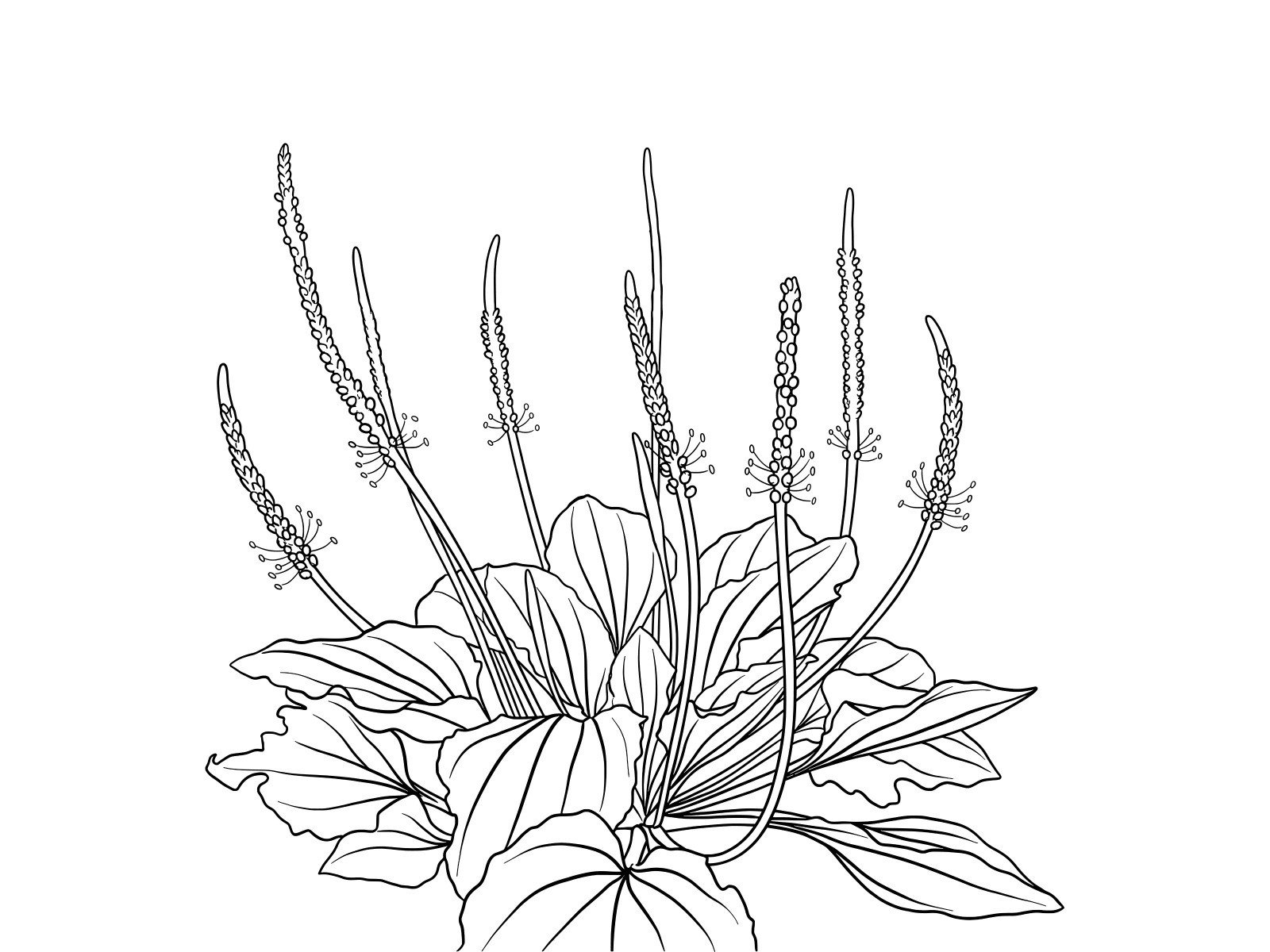
Look closely at a leaf. Can you see several straight lines going from the bottom to the tip? On the coloring page, you can see five thick lines drawn inside each leaf.
These are tough veins like hard strings, and they are super strong. Even when stepped on from above, these strings keep the leaf from tearing. They do not break easily even if you pull a bit. Pick one leaf and gently pull it to try. You should see white, thread-like strings inside stay behind.
Its Japanese name means "big leaf"
When written in Japanese kanji, Plantain's name means big leaf child. Just as the letters say, it got this name because it has big, wide leaves.
The leaves grow out in a circle from one spot at the bottom, spreading flat on the ground. This shape is called a rosette. It stays low to the ground so it is safe even when stepped on from above.
The flowers look like thin sticks
From spring to fall (around April to September), thin, stick-like spikes grow straight up from between the leaves. These are the flowers of Plantain.
You might think, "Wait, is this a flower?" If you get close and look, you can see tiny flowers packed tightly from bottom to top. From the flowers, white thread-like stamens stick right out. Another cool thing is that the spike does not split into branches.
Seeds travel on the bottom of your shoes
When the flowers finish, small seeds grow on the spike. There are 4 to 6 seeds inside each fruit.
These seeds are amazing. When they get wet from rain, their outside turns sticky like jelly. Then they stick right onto the bottom of shoes or bike tires passing by. They travel far away like that and sprout again in a new place.
Plantain turned getting stepped on into a way to make more friends. It really is a smart plant!
How to Color Plantain
Color carefully so you do not rub out the leaf lines
The best part of this coloring page is the 5 lines running through the leaves. These are the most important features to help you spot Plantain.
If you press hard with a dark color here, you will cover up all the lines. Color gently with a light green so you can still see the lines.
If you want it to look extra cool, try coloring every other space between the lines just a little darker. This makes the leaves look bumpy and real!
Do not make every leaf the same green
Plantain leaves look bright green in the front, and dark green when they overlap underneath or in the back.
Get 3 colors ready: yellow-green, green, and dark green. Make the colors darker as you go from front to back to show how the leaves layer over each other. Even on a single leaf, it looks pretty if you make the bottom darker and the tip brighter!
Color the spike with 2 different colors
The long, thin flower spike is often light brown at the bottom and yellow-green at the top. This is because Plantain flowers bloom from the bottom first, working their way up.
Leave the sticking-out white stamens white without coloring them. That will make them look soft and fluffy!
Use light colors for the ground on the second page
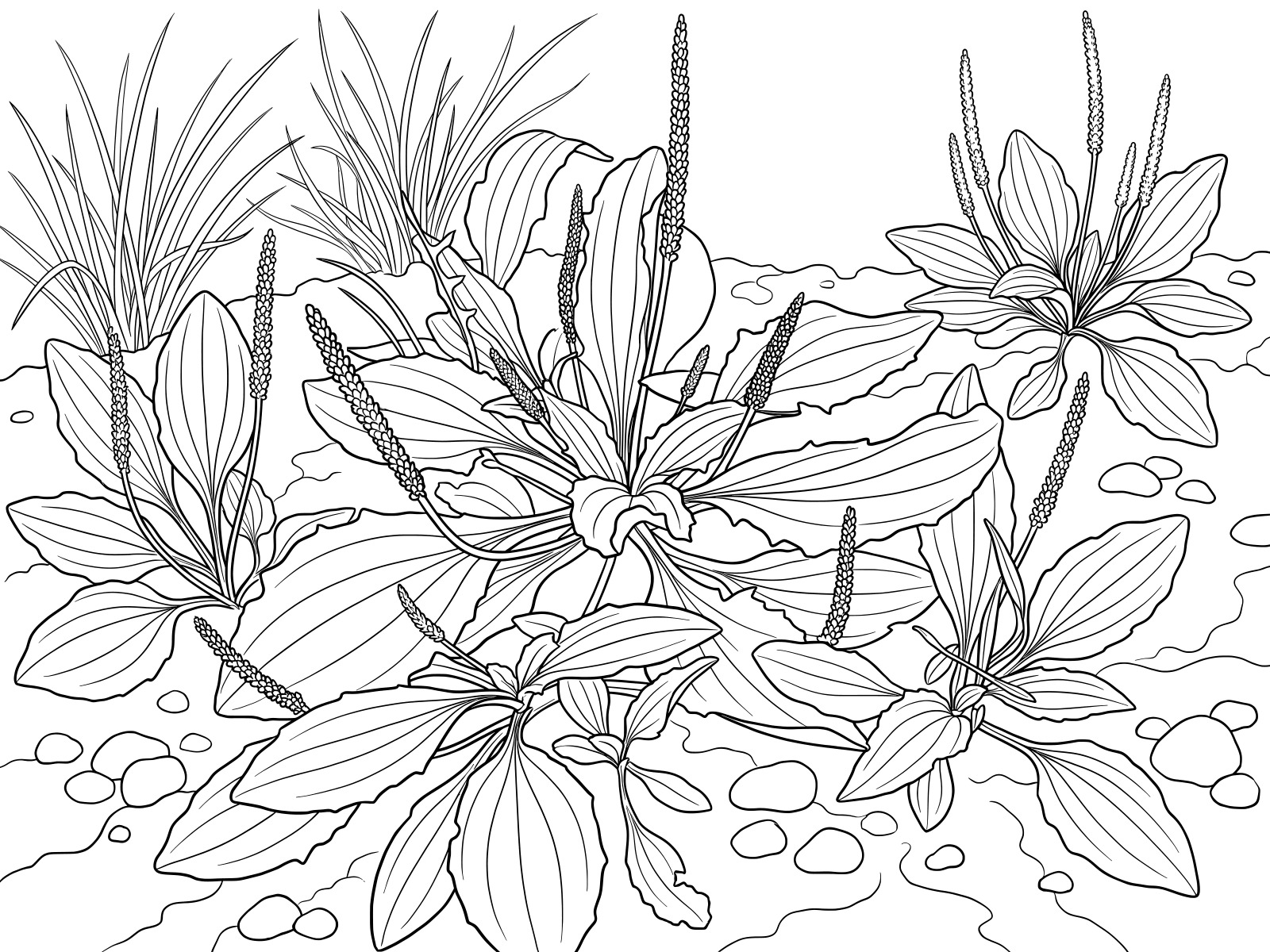
On the second page, you can see Plantain spreading all over the ground! If you color the ground and tiny stones with dark colors, the grass will get hidden.
Use light beige or gray for the ground, and a strong green for the grass. Changing the lightness like this makes the main star—Plantain—pop right out! If you change the color of the stones just a little bit one by one, it makes a fun picture.
Once you finish coloring, go find real Plantain in your schoolyard!
When you finish coloring, take this picture and go out to your schoolyard. Here is a secret tip: look for the place that gets stepped on the most!
Count the lines on the leaves and compare them to your picture to see if they match. How many flower spikes are standing up? When you compare the plant you colored with the real thing, your everyday schoolyard will look totally different!
Fun Facts About Plantain
A game called Plantain sumo
There is a game played with Plantain that has been around for a long time. It is called Plantain sumo.
It is easy to play. Two people each take one flower stalk, hook them together, and pull. The person whose stalk breaks first loses.
Do you pick a thick stalk, or a thin one that bends easily without breaking? There is actually a lot to think about! This game is so famous that Plantain even has another name: Sumotorigusa, which means "sumo wrestler plant".
The sticky stuff on the seeds has a name
Plantain seeds get sticky when they get wet. This sticky stuff is called mucilage.
What is amazing is how much of it there is! Just by getting wet, it quickly creates sticky goo that is bigger than the seed itself. That is why it sticks tightly to the bottoms of shoes and can travel far away.
If it stops getting stepped on, it disappears
You might think, "I feel sorry for it because it gets stepped on," but for Plantain, it is the opposite.
Places where people step are too tough for other plants to live in. There, Plantain can have all the sunlight to itself! In places where it stops getting stepped on, it loses to taller plants and disappears before you know it.
If Plantain vanishes from your schoolyard, that might be a sign that nobody walks there anymore.
The lines in the leaves are strong strings
If you pull a Plantain leaf, white string-like things come out from inside. These are the strong leaf veins.
Because it has these lines, the leaf does not tear even when stepped on from above. It bends gently to handle the force and stands right back up. Plantain's strength comes from these lines in its leaves.
Share These Plantain Coloring Pages



-
Broadleaf plantain
-
Broadleaf plantain spreading on the ground
-