Creeping woodsorrel Coloring Pages
 ~
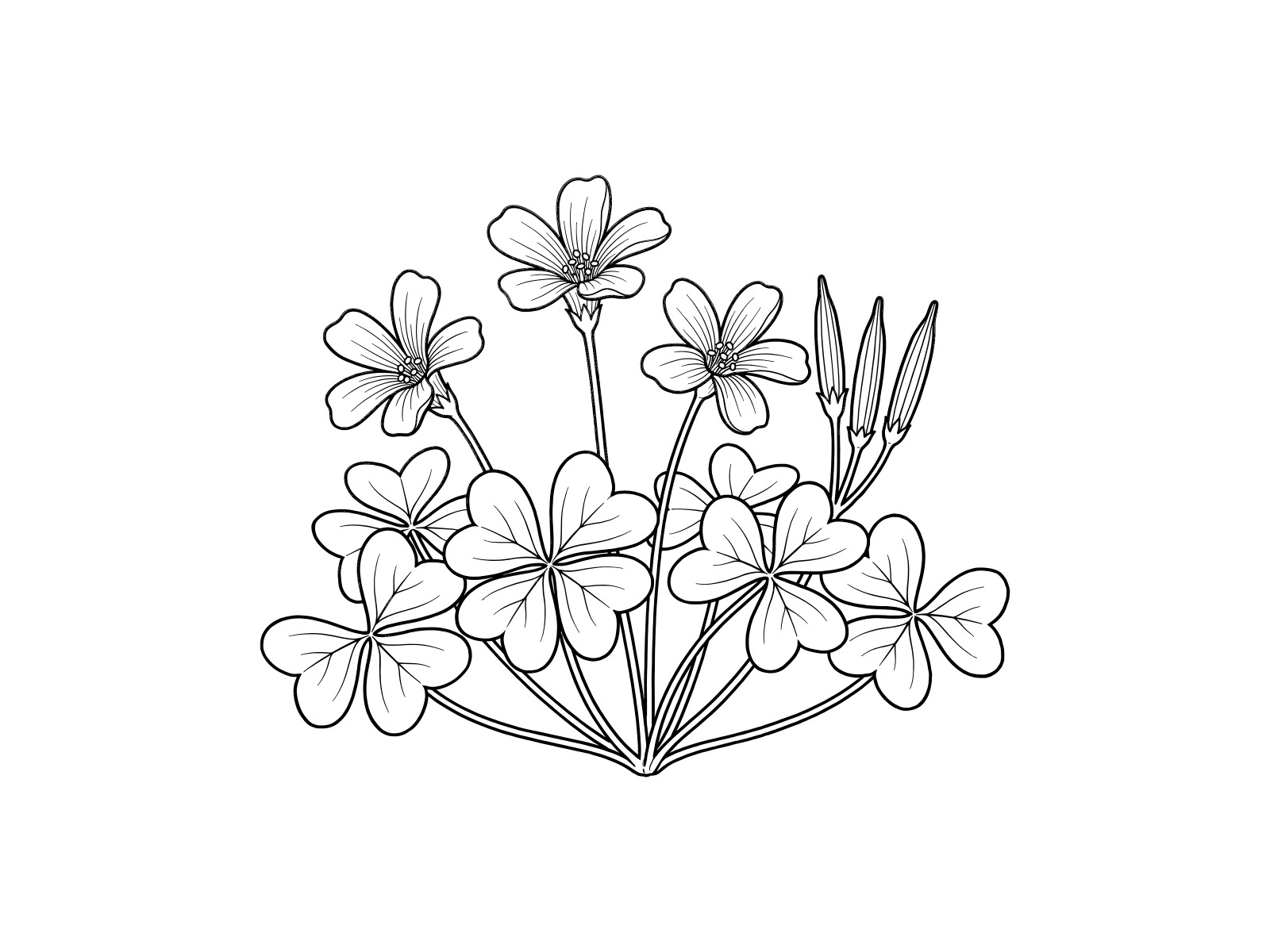
~ 
About Creeping woodsorrel
A plant that is easy to mistake for clover
Creeping woodsorrel is a tiny plant you can find in the corners of schoolyards, along flower beds, and in sidewalk cracks. It has three leaves, so you might have thought, "Oh, it's clover!" and looked for a four-leaf one.
Actually, Creeping woodsorrel is a completely different plant from clover! I will tell you how to tell them apart in a little bit.
Leaves that look like they've been "eaten"
In kanji, Creeping woodsorrel is written as 片喰. It means "one side was eaten."
Why is that? Because the tip of each tiny leaf dips down into a deep V-shape. It really looks like someone took a bite out of it, doesn't it? So people called it "Katabami" (eaten side)—and that is how it got its Japanese name.
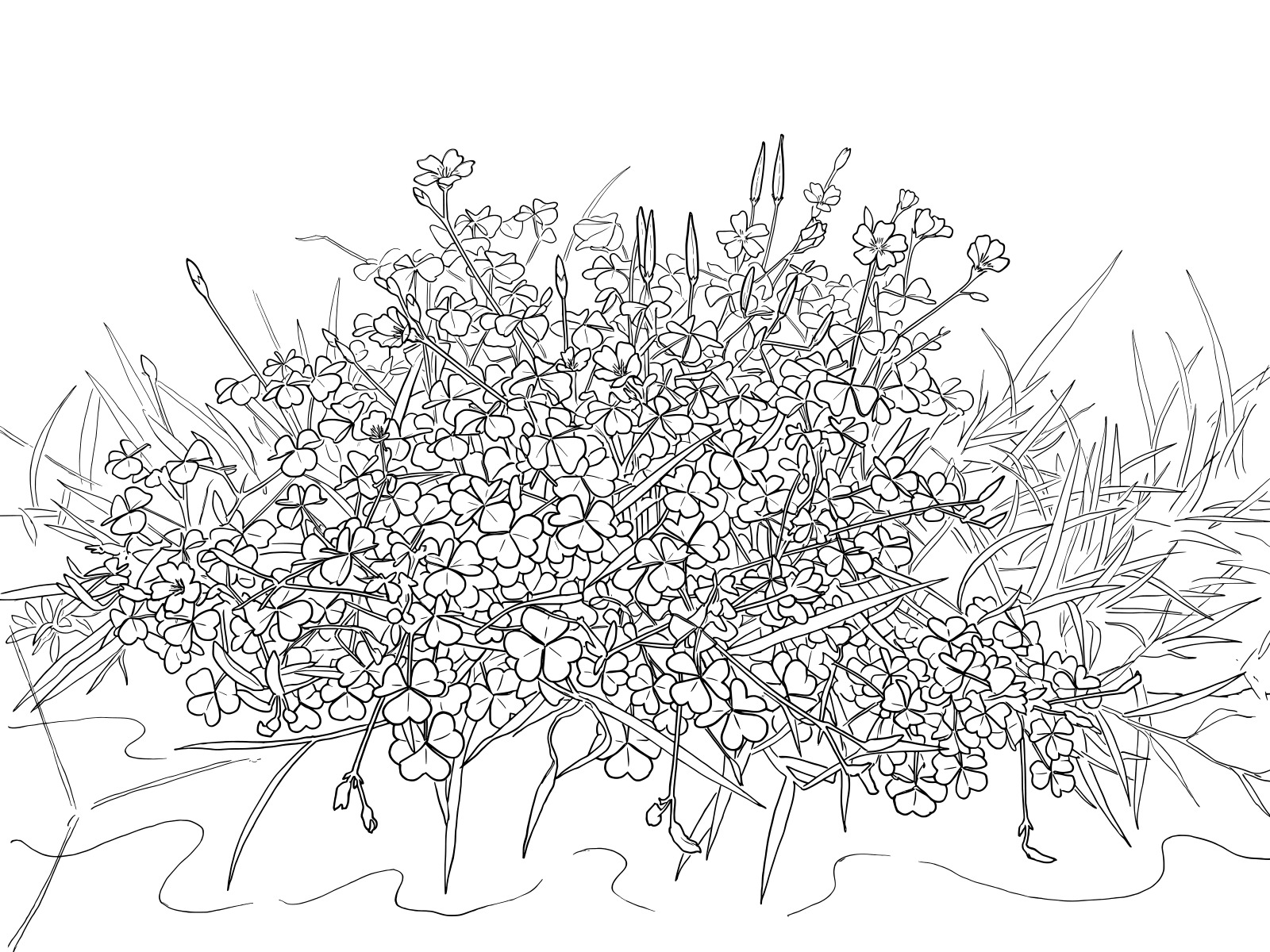
Look closely at your coloring page. Can you see how the tips of the heart-shaped leaves split into a clear V-shape?
It closes its leaves at night
Creeping woodsorrel has an even more surprising trick. When night comes, it closes its leaves super tight.
During the day, its three leaves spread out wide. But when it gets dark, they fold down and close up just like an umbrella! Then, when morning comes, they open right back up.
Go take a look at the Creeping woodsorrel in the schoolyard late in the afternoon when school is over. It will look completely different from how it looks during the day!
Tiny yellow flowers and seeds that look like rockets
The flowers are yellow, and they have 5 petals. They are very tiny, less than 1 centimeter wide. They keep blooming one after another for a long time, from spring to autumn.
Did you spot the long, slender tube-like fruit standing straight up next to the flowers? It looks a bit like a tiny okra.
This fruit is amazing. When you gently touch a ripe fruit, it pops with a snap, and the red seeds inside shoot out with lots of power. They can fly as far as 1 meter!
How to Tell it Apart from Clover
Now, here is how to tell them apart. When you put them side by side, they are actually totally different!
Look at the tips of the leaves. The leaf tips of Creeping woodsorrel have a deep V-shaped notch. Clover leaves are round, and their notches are very shallow.
Look at the leaf patterns. Clover leaves have white chevron patterns, but Creeping woodsorrel leaves do not.
Look at the flower colors. Creeping woodsorrel flowers are yellow, and clover flowers are round white clusters. This is the easiest way to tell them apart!
By the way, Creeping woodsorrel belongs to the woodsorrel family, and clover belongs to the pea family, so they are not even in the same plant family. That is why it is super hard to find a four-leaf leaf on Creeping woodsorrel!
The plant that makes 10-yen coins shiny
Creeping woodsorrel leaves contain a sour element called oxalic acid. They taste sour when you chew them, so some places even call this plant "suimonogusa" (sour herb).
This oxalic acid works to remove dark dirt from metal. That means if you rub a dull 10-yen coin with Creeping woodsorrel leaves, it becomes shiny! People long ago used this plant to polish mirrors and altar items. That is why some places also call it Kagamigusa (mirror herb).
How to Color Creeping woodsorrel
Color the V-shapes on the leaves without hiding them
The best part of this Creeping woodsorrel coloring page is the deep V-shaped dips at the tips of the leaves. These shapes are the secret to spotting Creeping woodsorrel, so try to color around them neatly.
The trick is to color the leaves one by one along their outlines. If you try to color all 3 leaves at once, the V-shapes might disappear!
Yellow-green is a great color to use. Creeping woodsorrel leaves are a brighter, softer green than clover leaves.
You can use plain yellow for the flowers
Creeping woodsorrel flowers are bright yellow. Keep it simple and color them all in yellow.
If you want to try a little harder, make the base of the petals dark orange and the tips bright yellow. Follow the lines on the petals as you shade to make them look like they are blooming wide open.
Leave the stamens in the middle of the flower white without coloring them.
The seed pods change from green to brown
The long, thin seed pods pointing upward are green when they are young, and turn brownish as they ripen.
So, if you color some green and some brown, they will look like they are ready to pop open! Color along the straight lines to make the tube shape stand out.
Give the stems a reddish color
It might surprise you, but Creeping woodsorrel stems are often reddish instead of green.
Try coloring the stems with red-brown or light reddish-purple. Next to the yellow-green leaves, they will look just like the real thing! If you notice this detail, you are a true nature expert!
After coloring, take a 10-yen coin to the schoolyard
When you finish coloring, grab a dull 10-yen coin and go to a corner of the schoolyard.
Pick a few Creeping woodsorrel leaves and rub them hard against the coin. It will get amazingly shiny! The sour juice inside the leaves cleans off the dirt.
While you are there, check the V-shapes on the leaf tips too. Do they look just like your drawing?
Fun Facts About Creeping woodsorrel
Seeds Can Fly Up to 1 Meter
When the long pod of Creeping woodsorrel gets ripe, it pops open with just a light touch. Red seeds shoot out with great power.
Believe it or not, they can fly up to 1 meter away! Plants cannot move by themselves, so this is how they spread their family far and wide.
If you find a ripe pod in the schoolyard, try gently pinching it with your fingers. You will feel it pop softly right in your hand!
A Family Crest Loved by Samurai
The shape of the Creeping woodsorrel leaf was even used as a family crest. It was called the Katakabami-mon, and it was so popular that it became one of Japan's top ten family crests.
The reason for its popularity was how tough Creeping woodsorrel is. Once it grows, it is very hard to wipe out, so people believed it meant "the family line will never end." Famous warlords like Uesugi Kenshin, the Chosokabe clan, and the Sakai clan all used it.
Isn't it amazing to think that a tiny weed in the schoolyard was once drawn on real castle flags?
Why It Was Called "Mirror Grass"
Creeping woodsorrel has another name: Mirror Grass. That is because the special juice inside its leaves can polish cloudy metal and make it shine.
People long ago used this plant to polish mirrors and temple tools. Back when there were no glass mirrors, mirrors were made by polishing flat pieces of metal.
Even today, you can test this power by rubbing a 10-yen coin with the leaves. You can try the exact same trick that people used hundreds of years ago!
Not Even Relatives of Clover
Creeping woodsorrel and clover look almost identical with their three leaves. But these two actually belong to different plant families—which means they are not related at all!
Creeping woodsorrel belongs to the Oxalis family, while clover (white clover) belongs to the Bean family. The Bean family is the same group that edamame and broad beans belong to.
They only look alike by chance! Two totally different plant families just happened to end up with the same leaf shape.
Share These Creeping woodsorrel Coloring Pages




-
Creeping woodsorrel
-
Creeping woodsorrel
-