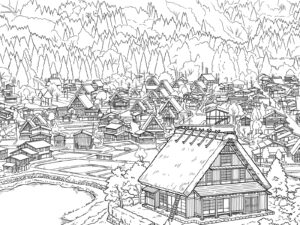
Gassho-style Houses of Shirakawa-go Coloring Pages
 ~
~ 
About Gassho-style Houses of Shirakawa-go
The Name Comes from "Hands Put Together"
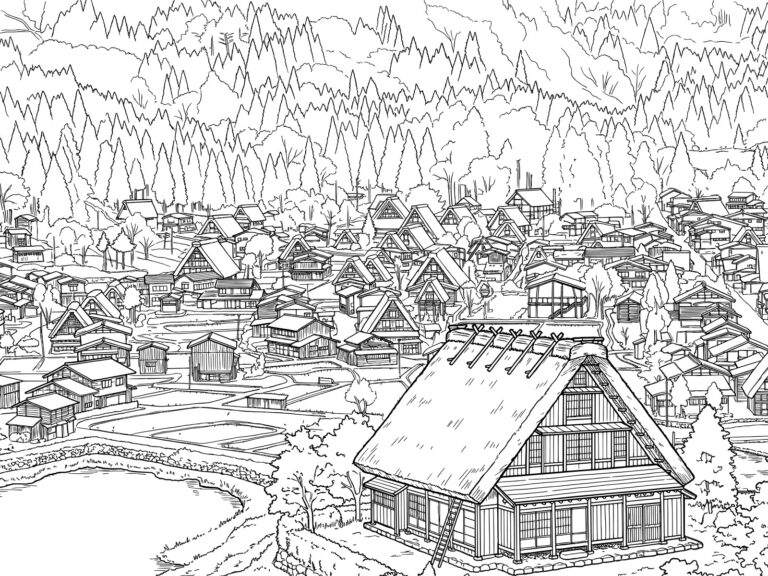
Shirakawa-go is a village in the mountains of Gifu Prefecture. Here, you can find unique homes called Gassho-style Houses of Shirakawa-go.
Take a look at the roof. It looks like two palms placed together in prayer, right?
People think it got this name because the wooden frames of the roof form a triangle, just like putting your hands together.
In the Ogimachi area, more than 100 big and small Gassho-style Houses of Shirakawa-go still stand today, and people are still living in them.
Steep Roofs Help the Snow Slide Off
The roof of a Gassho-style Houses of Shirakawa-go is very steep. It tilts at an angle of 45 to 60 degrees.
Shirakawa-go gets some of the heaviest snow in Japan, and a lot of snow piles up on the roofs in winter.
When the roof is steep, the piled-up snow slides down all by itself. This makes the hard work of clearing the snow much easier.
It rains a lot here too, so the steep slope also helps rain run off quickly.
The Attic Has 2 or 3 Floors for Raising Silkworms
A steep roof brings another great benefit. It creates a huge attic space.
The attic of a Gassho-style Houses of Shirakawa-go is split into two or three levels. It is almost like having another house inside!
In the old days, people in Shirakawa-go raised silkworms in these attics. Silkworms are insects that make silk threads.
Since the village had many mountains and few rice fields, people earned their living by selling silk.
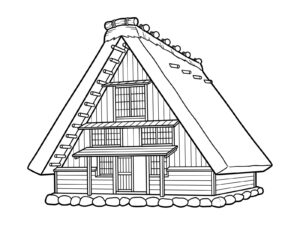
The windows lined up on the triangular side of the coloring page let light and wind into the attic.
Tied with Ropes Without Using a Single Nail
The roof frame of a Gassho-style Houses of Shirakawa-go is built without using a single nail.
Thick wooden beams are tied together tightly with strong ropes.
Because it is not locked tight with metal parts, the knots shift a little bit to release the force when heavy snow or strong winds shake the house.
Making the house flexible helps it last longer than making it rigid. That is smart thinking from long ago!
Every House Roof Faces South and North
If you look at the Gassho-style Houses of Shirakawa-go from above, you will notice something cool. The triangular sides of every house face South and North.
There are three reasons for this. First, sunlight hits the wide side of the roof evenly, melting the snow and drying the thatch well.
Second, this valley is long and thin from north to south, so strong winds blow from the north and south. Facing the triangular side into the wind keeps the wind-pushing area as small as possible.
Third, opening the attic windows in summer lets the north-south breeze blow right through, keeping the silkworms cool and healthy.
How to Color Gassho-style Houses of Shirakawa-go
The roof is light brown. Leave the spaces between the lines white
The thatched roofs are made by tying together bundles of dried grass. Try coloring them with light brown or light ochre.
You can see many short lines on the roof, right? If you cover these lines with brown, it will not look like real grass anymore.
Leave the spaces right next to the lines white, and color the surface softly. Just doing that will make it look nice and fluffy like real thatch!
A brand-new roof looks close to yellow, while older roofs look more greyish. Choose the color you like best!
The wooden walls are dark brown, and the Shoji screens stay white
The triangular sides and the walls on the first floor are wooden walls made of stacked boards. If you color them dark brown, they will stand out clearly against the light brown roof.
The square windows lined up on the walls are Shoji screens. We recommend leaving them white.
If you color inside the tiny grid lines, the coloring page will look messy. Just color the frames brown and leave the inside white. That alone makes them look like real Shoji screens!
Color each stone in the foundation a little differently
At the base of the house, there are round stones lined up. Try not to color them all the exact same grey.
Color the stones next to each other using different shades, like light grey, dark grey, and brownish grey.
By using different colors, people can tell that the stones were carried from the river one by one to build the base!
Leave the lines between the stones white without coloring over them.
Leave the snow white. Add just a stroke of light blue to the icicles
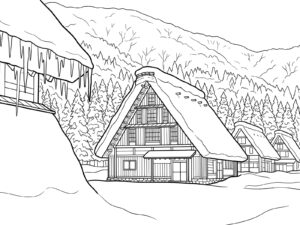
For pictures with snow, the snow looks prettiest if you do not color it at all. The white of the paper becomes the snow!
If it feels a bit plain to you, try adding just a tiny bit of light blue to the shady spots. You do not need to color the whole area—just under the edges of the roof or under the right side of the snow mounds is enough.
The icicles hanging from the eaves are long, thin triangles. Leave the inside white too, and draw just one light blue line down the middle. This makes them look clear and see-through!
When you color the thatched roof and wooden walls with a nice, strong brown, the white snow will pop even more!
The cedar forest is dark green, while the sky and water stay white
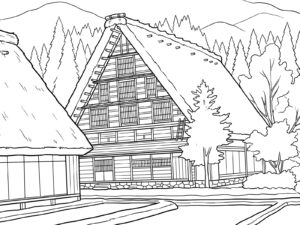
In pictures with a background, pointed cedar trees stand in a row on the mountain behind the house. Try coloring them dark green.
When the background is dark and neat, the thatched roof in front really jumps out at you!
The sky and the water in the rice field do not have lines drawn on them. Leaving them white is the right choice!
Not coloring every single spot helps show the clear, crisp air of the snow country.
Fun Facts About Gassho-style Houses of Shirakawa-go
Re-thatching the roof is finished in just one day by the whole village
A thatched roof is completely replaced about once every 30 to 40 years.
The surprising thing is how fast they do it! As a rule, they re-thatch a big roof in just one single day.
They finish in one day because if it rains while they work, the attic will get wet. Also, they usually do this in early spring, and once farm work starts, they cannot gather people for many days.
That is why dozens of people climb up on the roof all at once!
"Yui" is a promise to help each other
A rule of helping each other called yui has supported this huge task.
Neighbors form a group, and when a home re-thatches its roof, the whole village gathers to lend a hand.
They do not hire people with money. It is a promise where you go to other homes to help so they will come to help at your home, too.
This system has continued because it is a village where people made it through snowy winters together.
The reason it became a World Heritage Site is not just the buildings
In 1995, Shirakawa-go was registered as a UNESCO World Heritage Site along with Gokayama in Toyama Prefecture.
It was praised for more than just its rare home shapes.
People say the site was chosen because it includes the way of life of the locals, who have protected their homes and scenery by helping each other.
Even before it became a World Heritage Site, the Japanese government chose it in 1976 as an important village district to protect.
The biggest home belongs to the Edo-period village leader
Among the Gassho-style Houses of Shirakawa-go in Ogimachi, the Wada House is especially big.
It was the home of the village leader who brought the village together in the Edo period, and it is a Important Cultural Property of Japan.
It is one size bigger than regular Gassho-style Houses of Shirakawa-go, and it even has a special entrance to welcome important guests.
The owners still live there and protect it today, and you can go inside to take a look!
Share These Gassho-style Houses of Shirakawa-go Coloring Pages


-
Gassho-zukuri House
-
Gassho-zukuri Houses in Shirakawa-go
-
-
Shirakawa-go in the Snow
-
Shirakawa-go village (detailed)
-