Kurashiki Bikan Historical Canal Area Coloring Pages
 ~
~ 
About Kurashiki Bikan Historical Canal Area
A merchant town from the Edo period, built along a river
The Kurashiki Bikan Historical Canal Area is an old town area in Kurashiki City, Okayama Prefecture.
The Kurashiki River flows right through the middle of town, and storehouses with white walls and traditional townhouses stand side by side on both banks.
In 1642, Kurashiki became a Tenryo, a land ruled directly by the Edo government.
The Kurashiki River was connected to the sea, so long ago, boats carried rice paid as taxes and other goods along it. That is why so many storehouses were built along the river!
White plaster walls and sea cucumber walls
The most famous feature of the storehouses in Kurashiki is their white plaster white walls and sea cucumber walls.
A sea cucumber wall is made by putting flat, square tiles on the wall, then putting white plaster over the gaps between the tiles so it sticks out rounded, like a loaf of bread.
It got this name because the bumpy gaps look like the sea creature called a sea cucumber!
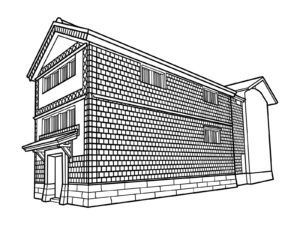
The 1st coloring page shows a storehouse where you can clearly see the sea cucumber wall.
A row of willow trees and riverboats
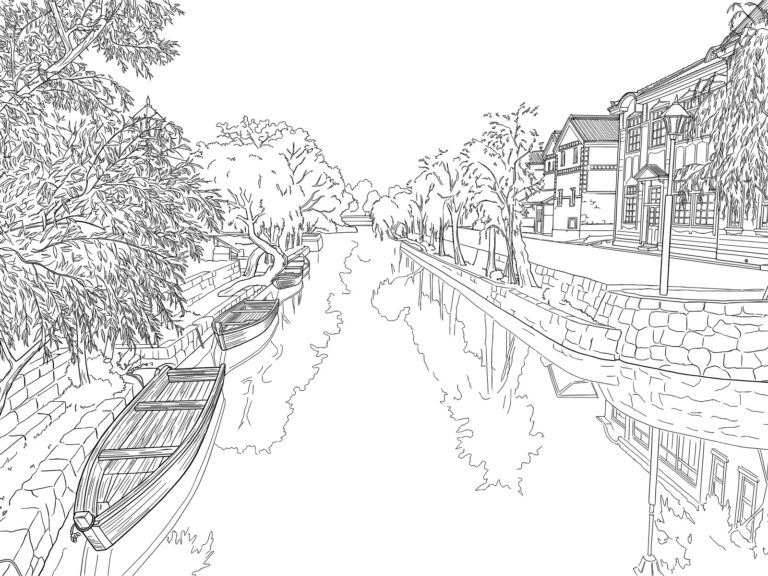
Along the banks of the Kurashiki River, a row of willow trees goes on and on.
On the river, you can enjoy the "Kurashiki Riverboat Tour," where you look at the town while riding in a small boat rowed by a boatman.
Up to 6 people can ride in one boat. Seeing the white-walled town from the water gives you a totally different view than looking from the road!
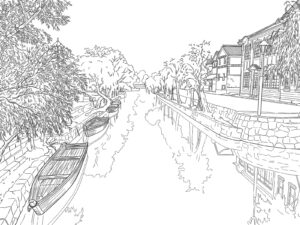
The 3rd coloring page shows the willow trees and the boat landing.
A town chosen by the country
The town area around the Kurashiki River was chosen as a national Important Preservation District for Groups of Traditional Buildings in 1979.
Just like the gassho-style houses of Shirakawa-go with their white walls, the town of Hida Takayama with its wooden lattices, and Ouchi-juku with its thatched roofs, it is a town that carefully protects the way people used to live.
Even though they are all "old towns," the colors and shapes of their roofs and walls are so different! Try comparing them.
Kurashiki lattices and townhouse design
On the first floor of Kurashiki townhouses, there are special wooden screens called Kurashiki lattices that you can only find in this town.
They have a neat design where three thin wooden strips, with their top ends cut short, sit between thick vertical wooden bars.
The roofs are made of overlapping tiles. The mix of white walls, black roof tiles, and wooden lattices creates the quiet, calm look that is so special to Kurashiki.
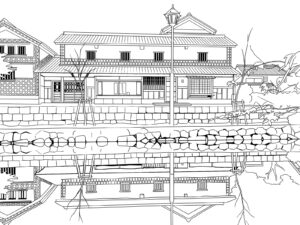
The 2nd coloring page shows white-walled townhouses and a storehouse with a diamond-patterned sea cucumber wall reflected on the river water.
How to Color Kurashiki Bikan Historical Canal Area
Leave the White Walls Uncolored
The white walls of the storehouses in the Kurashiki Bikan Historical Canal Area look best when you leave them plain white without coloring them.
Instead, color the roof tiles with dark gray or black. This will make the white walls pop and look bright!
Gray and White Patterns on the Namako Walls
For the namako walls, color the square tiles gray or dark colors. Leave the raised seams white.
If you carefully color each square one by one, the pattern of white lines will stand out nicely.
It takes time, but it will look super pretty when you finish!
Show the Willows and Sky Reflected in the Canal
Try coloring the water of the Kurashiki River in a greenish light blue.
Color the white walls and willow trees reflected on the water using the same colors as the real ones above, but make them a bit lighter. That way, they will look like real reflections!
For the willow leaves, mix yellow-green and green, and color along the shape of the drooping branches.
The Boat and Stone Canal Banks
Try coloring the river boat in wood colors and the stone bank in gray.
If you change the shade of gray a little bit for each stone, it will look like real rough stone!
Use the Same Color for the Sky and Water
When you color a picture with reflections on the water, use the same light blue for the sky and the canal. The top and bottom will blend together and look like a shiny mirror!
The trick is to color the buildings in the water just a little lighter than the real buildings above.
Color Willow Branches Along the Lines
In the third coloring page, color the willow tree by moving your colored pencil from top to bottom along the drooping branch lines.
If you switch between yellow-green and green for each clump of leaves, it will look like a willow swaying in the wind!
Fun Facts About Kurashiki Bikan Historical Canal Area
The First Western Art Museum in Japan
In the Kurashiki Bikan Historical Canal Area, there is the Ohara Museum of Art. It opened in 1930 and was Japan's first private art museum focused on Western art.
At the entrance, you can see thick pillars just like a Greek temple.
A temple-like building inside a town of white-walled storehouses is a special view you can only see in Kurashiki.
Red Brick Factory Covered in Ivy
Next to the Kurashiki Bikan Historical Canal Area, there is a red brick building called Kurashiki Ivy Square.
It was originally a factory built in the Meiji period to make thread.
The ivy covering the walls was planted to help cool down the hot temperatures inside the factory.
The Birthplace of Japanese Jeans
The Kojima area in Kurashiki City is known as "the birthplace of Japanese jeans."
In 1965, the very first jeans made in Japan were sewn here.
In the Kurashiki Bikan Historical Canal Area, you can find shops selling denim items, and even blue soft-serve ice cream!
The Town Lit Up at Night
At night in the Kurashiki Bikan Historical Canal Area, lights shine on the white-walled storehouses and willow trees.
You can enjoy a calm and cozy town view that is different from the daytime.
Share These Kurashiki Bikan Historical Canal Area Coloring Pages


More Towns, Houses & Shops Coloring Pages
-
Storehouse with namako walls
-
Townscape Reflected in the Kurashiki River
-
-
Willow and Riverboat (Detailed)
-