Yasaka Pagoda and Hanamikoji Street in Kyoto Coloring Pages
 ~
~ 
About Yasaka Pagoda and Hanamikoji Street in Kyoto
Yasaka Pagoda and Hanamikoji Street in Kyoto soaring in Higashiyama
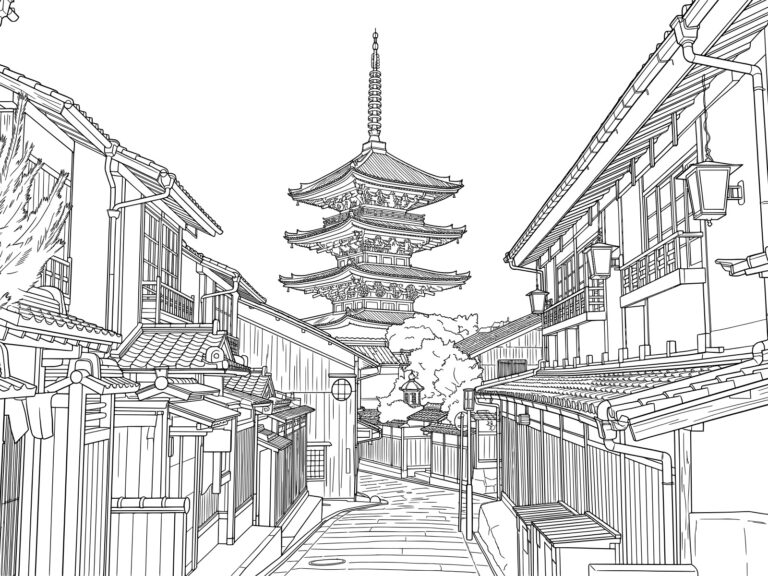
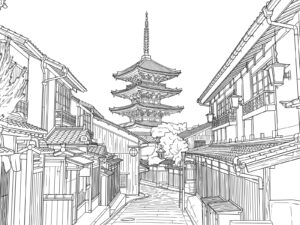
A five-story pagoda sticks straight up into the sky from the streets of Kyoto's Higashiyama. This is the Yasaka Pagoda and Hanamikoji Street in Kyoto.
Its official name is the five-story pagoda of Hokkanji Temple.
People say that Prince Shotoku built this temple.
The pagoda you see today was rebuilt in 1440 by the shogun Ashikaga Yoshinori. It is a national Important Cultural Property.
It has 5 stacked roofs. On the very top stands a pole with many stacked rings called a Sorin.
Stone-paved slopes and traditional townhouses
Stone-paved slopes stretch around the Yasaka Pagoda and Hanamikoji Street in Kyoto, lined with old townhouses.
Nearby are Sanneizaka and Nineizaka, which lead to Kiyomizudera Temple. In 1976, this whole area was chosen as a national Important Preservation District for Groups of Traditional Buildings.
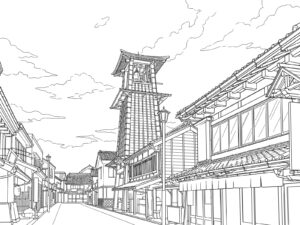
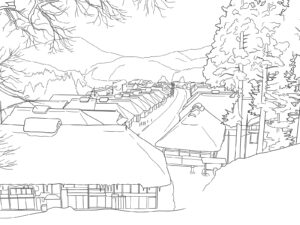
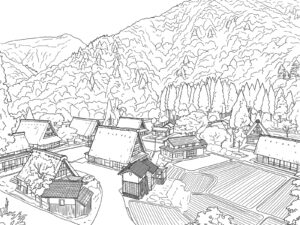
Up the slope is Kiyomizudera Temple. The 3rd coloring page shows the sloping street where you can see the Yasaka Pagoda and Hanamikoji Street in Kyoto between the townhouses.
Hanamikoji Street in Gion
If you walk a little northwest from the Yasaka Pagoda and Hanamikoji Street in Kyoto, you will find a town named Gion.
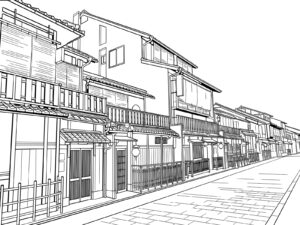
Along Hanamikoji Street in Gion, traditional wooden buildings called ochaya stand side by side.
In front of the ochaya, you can see reddish-brown bengara lattices and arched bamboo guards called inuyarai. They create a very traditional Kyoto feel.
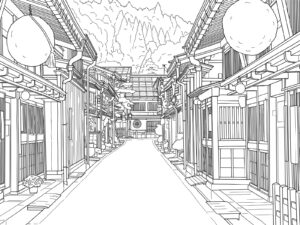
The street is paved with stones, and power lines are hidden underground. The 2nd coloring page shows this Hanamikoji Street.
The two streetscapes are in different places
The slopes of Higashiyama with the Yasaka Pagoda and Hanamikoji Street in Kyoto, and Gion with Hanamikoji Street, are close enough to walk between. But they are actually different areas!
In this article, we made these two classic Kyoto streetscapes into separate coloring pages.
It is also fun to compare the Yasaka Pagoda and Hanamikoji Street in Kyoto with the five-story pagoda at Toji Temple. Both are five-story pagodas with 5 roofs!
Kyoto townhouses are called "Eel's Nests"
Many traditional Kyoto townhouses have narrow front entrances along the street, but they are very long inside.
Because of this shape, people call them "Eel's Nests."
Lattice windows, bamboo blinds, and paper lanterns line the street, creating a calm, Kyoto-like neighborhood.
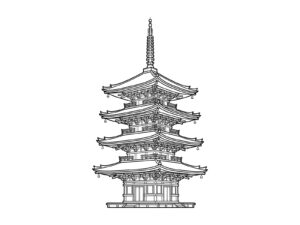
The 1st coloring page shows just the Yasaka Pagoda and Hanamikoji Street in Kyoto nice and big. Have fun carefully coloring the 5 roofs and the Sorin at the top!
How to Color Yasaka Pagoda and Hanamikoji Street in Kyoto
Layer colors for the pagoda roofs
The roof tiles of Yasaka Pagoda and Hanamikoji Street in Kyoto are dark gray.
The wooden beams and pillars under the roofs are dark brown. Leave the white walls as they are!
Color the 5 roofs a little lighter as you go up. This makes the pagoda look like it reaches into the sky.
If you color the finial on the top gold or yellowish brown, it will shine bright!
Townhouses use dark brown, white, and yellowish brown
The townhouses of Yasaka Pagoda and Hanamikoji Street in Kyoto are made of dark brown wood and yellowish-brown or cream-colored clay walls.
Coloring the wooden lattices reddish brown makes them look just like Gion!
Try coloring the bamboo guards light yellowish brown or brown.
Color the flagstones one by one
For the stone path, use light gray as a base. Try changing the shade just a bit for each stone.
Make the front stones darker and the back stones lighter. This makes the path look like it goes on far away!
Pick a season with the sky
Color the sky blue for a sunny day. Color it orange or purple to make it evening in Kyoto.
If you color the lanterns and streetlights yellow, your picture will look warm, like lights turned on at night!
Paper lanterns are red and white
Red paper lanterns hang in front of the teahouses along Yasaka Pagoda and Hanamikoji Street in Kyoto.
When you color the red lanterns against the dark brown townscape, they stand out right away!
Use bamboo colors for the curved guards
Color the curved bamboo guards in front of the teahouses light yellowish brown, just like real bamboo!
Fun Facts About Yasaka Pagoda and Hanamikoji Street in Kyoto
There are days when you can go inside the pagoda
There are special days when you can go inside Yasaka Pagoda and Hanamikoji Street in Kyoto to take a look.
You can see inside the first floor and even go up to the second floor.
However, you must be a junior high school student or older to go inside. Children who are 8 or younger can't go in, so please enjoy looking at it from the outside.
How "Sanneizaka" got its name
There are a few different stories about how Sanneizaka, the slope that leads to Kiyomizu-dera Temple, got its name.
One story says it is because people walked up this slope to pray at Kiyomizu-dera Temple so that "giving birth would go smoothly and safely."
People walked up this slope while wishing for healthy babies to be born.
If you see a Maiko
In Gion, you might see a Maiko wearing a beautiful kimono.
Maiko are training hard to become Geisha, and they are on their way to work.
So, please do not take photos without asking or chase after them. It is also good manners in Gion not to enter private streets that only shop staff can use.
You usually cannot enter Ochaya teahouses
Many Ochaya teahouses on Hanamikoji Street will not let you in unless a regular guest invites you.
Let's enjoy the lovely Kyoto atmosphere by looking at the streets from the outside.
Share These Yasaka Pagoda and Hanamikoji Street in Kyoto Coloring Pages


More Towns, Houses & Shops Coloring Pages
-
Yasaka Pagoda
-
Hanamikoji Street in Gion
-
-
Yasaka Pagoda and Cobblestone Slope (Detailed)
-