Ouchi-juku Coloring Pages
 ~
~ 
About Ouchi-juku
An Edo-period post town hidden in the mountains
Ouchi-juku is a town in the mountains of Shimogo Town, in southern Fukushima Prefecture.
Long ago, there was a road called the Shimotsuke Kaido that connected Aizu-Wakamatsu and Nikko. Ouchi-juku was a post town along that road.
A post town is a town where travelers stayed and where people passed cargo and horses to the next town.
The people of Ouchi-juku lived by running inns while also farming their fields. This was called "half inn, half farm."
More than 30 thatched-roof houses
On both sides of the main street in Ouchi-juku, thatched-roof houses line up with almost equal spacing between them.
There are more than 30 thatched-roof houses. A town with this many thatched roofs along a single street is very rare in Japan.
In 1981, it was chosen as a national Important Preservation District for Groups of Traditional Buildings. This is a special area that protects and keeps the old town streets looking like they used to.
Roofs different from Gassho-zukuri
Even though they are both thatched roofs, the shape is different from the Gassho-zukuri houses in Shirakawa-go and Gokayama.
Gassho-zukuri roofs were steep, sharp triangles, like pressing your hands together in prayer.
The roofs in Ouchi-juku are called hipped roofs, and they slope down on all four sides.
Also, every house is built with the short side of the roof facing the street. So when you stand on the street, you can see roofs of the same shape lined up in a nice pattern.
Water canals flowing on both sides of the street
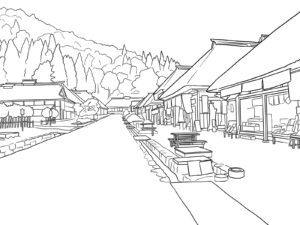
On both sides of the main street in Ouchi-juku, there are canals with clean water flowing through them.
Long ago, the water flowed right down the middle of the street, but it was moved to both sides later on.
In the summer, you can find shops cooling their vegetables and drinks in these canals.
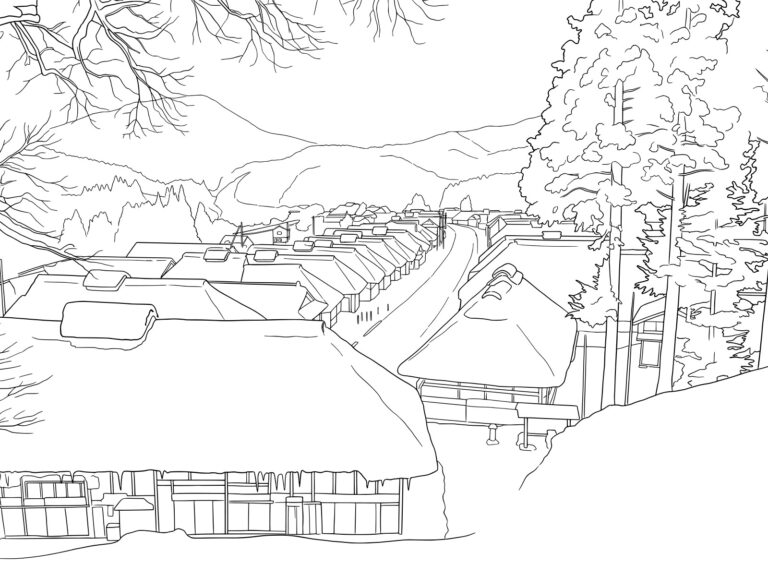
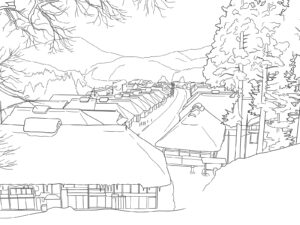
At the very back of the town, up on a hill, there is a viewpoint where you can look down at the town lined with thatched roofs. The third coloring page shows snow-covered Ouchi-juku as seen from this viewpoint.
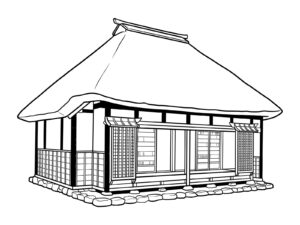
Page 1 shows a single house in Ouchi-juku
The first coloring page shows just one thatched-roof house in Ouchi-juku.
You can see how the thick thatched roof sticks far out past the walls. On the very top of the roof sits a small roof-like cover called a mune-osae.
On the front of the first floor, there is a porch with reed screen doors and wooden lattice doors. Today, many of these houses are souvenir shops and buckwheat noodle shops.
How to Color Ouchi-juku
Thatch roofs are dark brown and green
The roofs in Ouchi-juku are made of a grass called thatch.
Old thatch turns dark brown or gray, and moss grows in some spots, making it look a bit green.
If you color it dark brown first and then add a little bit of green near the bottom of the roof, it will look just like real old thatch!
The contrast between white walls and black pillars
The walls of the house have white plaster on top and dark brown wooden boards on the bottom.
If you leave the white parts uncolored and color the posts firmly in black or dark brown, it will look sharp and just like a real town house!
Try coloring the reed screen door in a light yellowish-brown.
The pictures of highway towns show the colors of the ground and the sky
For the second picture of the highway, try coloring the road light beige, the stones in the waterway gray, and the water light blue.
For the mountains in the back, try red, orange, and yellow for autumn, or green for summer. It is fun to pick a season before you color!
For a snowy scene, use the white paper!
For the third snow picture, the secret is to leave the snow uncolored and white.
Instead, if you color the sky light gray or light blue, and color the house walls and tree trunks in dark colors, the white snow will really stand out!
If you add just a tiny bit of light blue where the snow on the roof makes a shadow, the snow will look soft and fluffy.
Make the Ridge Caps Stand Out
The mune-osae on the very top of the roof is made of wood or boards.
If you color it dark brown or black, the shape of the roof will look nice and sharp.
Fun Facts About Ouchi-juku
Soba Noodles Eaten with a Whole Green Onion
The famous food in Ouchi-juku is negi soba.
Believe it or not, you use one whole long green onion as chopsticks to eat your soba noodles!
You can bite the green onion as you eat, using it as a tasty topping. A soba shop in Ouchi-juku came up with this clever idea, and now it is famous all over town.
The Snow Festival Lit by Snowy Lanterns
In Ouchi-juku, a Snow Festival is held every year on the second Saturday and Sunday of February.
People line up lanterns made of snow along the main street and light fires inside them.
It is said that the soft, glowing lights in the snow-covered town with thatched roofs look super pretty.
Townspeople Protect the Roofs Together
Thatched roofs need to be re-thatched every few years.
In Ouchi-juku, they keep places called kayaba around the town to grow the thatch used for the roofs.
Re-thatching is done through a helpful teamwork system called Yui, where the townspeople join forces. Young people practice too, keeping the special skills alive.
The Name Takato Soba
Negi soba in Ouchi-juku is also called Takato soba.
Takato is a place name in what is now Nagano Prefecture. It is said that the soba got this name because a lord who grew up in Takato became the lord of Aizu.
Share These Ouchi-juku Coloring Pages


More Towns, Houses & Shops Coloring Pages
-
Thatched-roof houses of Ouchi-juku
-
Street of Ouchi-juku
-
-
Ouchi-juku in the Snow (Detailed)
-