Gokayama Gassho-zukuri Historic Village Coloring Pages
 ~
~ 
About Gokayama Gassho-zukuri Historic Village
A World Heritage Site Alongside Shirakawa-go
Gokayama is an area in the mountains of Nanto City, Toyama Prefecture.
Two villages still remain here with houses that have steep triangular roofs that look like hands pressed together in prayer. This style is called Gassho-zukuri.
These two villages are named Ainokura and Suganuma.
In 1995, they were registered as a World Heritage Site called "Historic Villages of Shirakawa-go and Gokayama" along with Ogimachi in Shirakawa-go, Gifu Prefecture.
You can find the Shirakawa-go coloring page in the Gassho-zukuri Village of Shirakawa-go article, so compare them and see what you find!
20 Houses in Ainokura, 9 Houses in Suganuma
There are 20 Gokayama Gassho-zukuri Historic Village houses left in Ainokura Village. The houses stand in a long, flat area halfway up the mountain, surrounded by rice fields, vegetable gardens, stone walls, and woods.
Suganuma Village is a small village with only 9 Gokayama Gassho-zukuri Historic Village houses. It sits right where a river named the Sho River makes a big bend. River waters surround it on three sides, and a steep mountain rises behind it.
People still live in both of these villages today!
It takes about 30 minutes by car to get from Shirakawa-go to Gokayama. You can also travel between them on the "World Heritage Bus," so many people visit both places together.
How to Tell Gokayama Apart from Shirakawa-go
Gokayama Gassho-zukuri Historic Village houses look very much like the houses in Shirakawa-go, but there are a few tricks to spot the difference.
One trick is to look at where the entrance is. Shirakawa-go houses usually have their main door on the long side under the slope of the roof. Gokayama houses have their entrance right under the triangular wall side.
Another trick is the angle of the roof. Gokayama gets a lot of wet, heavy snow, so many houses have even steeper roofs than Shirakawa-go. Some roofs tilt at nearly 60 degrees!
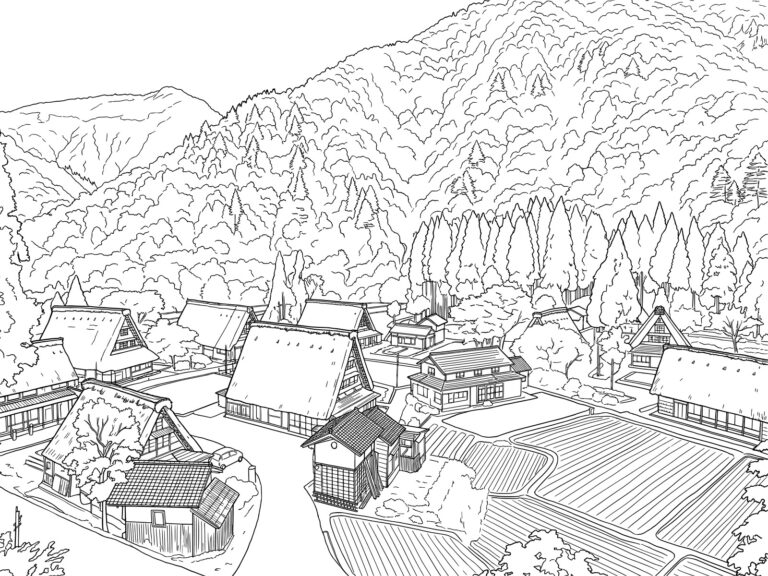
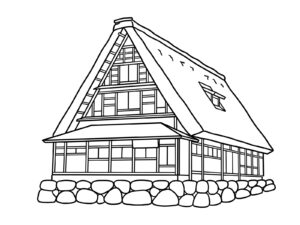
The first coloring page shows a classic house from Gokayama Gassho-zukuri Historic Village, with an overhang eaves and entrance right under the triangular side.
Roofs Covered in Snow During Winter
Gokayama is one of the snowiest places in Japan. In winter, snow piles up 2 to 3 meters deep, and in heavy snow years, it can even pass 4 meters!
Steep roofs are a smart way of living that helps snow slide off on its own.
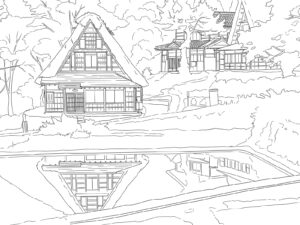
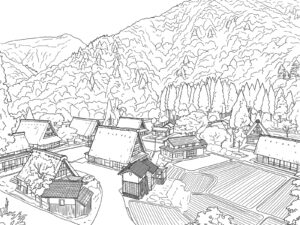
The second coloring page shows a Gokayama Gassho-zukuri Historic Village house reflected upside down in a water-filled rice field in spring. The third coloring page shows Suganuma Village as seen from high above.
How to Color Gokayama Gassho-zukuri Historic Village
Color the thatched roof brown and gray
The roof of a Gokayama Gassho-zukuri Historic Village house is made of grass called thatch.
New thatch is a light yellowish brown, and it turns a grayish brown over time.
Color the whole roof light brown, and then layer a little gray near the bottom to make it look like real old thatch!
The wooden walls are dark brown, and the paper screens are white
The triangle-shaped sides and the walls on the first floor are made of dark brown wooden boards.
If you leave the paper screen windows white, they will stand out nicely against the dark brown walls.
For the stone wall at the bottom, try coloring each gray stone in a slightly different shade!
Make the reflection in the rice field a little lighter
In the second picture, the house is reflected upside down in the water of the rice field.
The trick for the reflection is to use the same colors as the house above, but color it a little lighter.
Color the water light blue or light green first, and then lightly layer the colors of the house on top to make it look like a reflection in the water.
For the surrounding forest, color different groups of trees using light green and dark green!
Color the village by dividing the roofs and fields
The third picture shows Suganuma Village, featuring thatched roofs, tiled roofs, rice fields, farm fields, and mountain forests all together.
To make this detailed picture easy to understand, decide on a color for each thing! Use brown for thatched roofs, dark gray or blue for tiled roofs, light blue for rice fields, and light green and brown for farm fields.
For the mountain trees, make the ones in front bright and the ones in the back dark to give the mountain a sense of depth!
Fun Facts About Gokayama Gassho-zukuri Historic Village
Making Gunpowder Ingredients Under the Floor
Gokayama Gassho-zukuri Historic Village was deep in the mountains, so people could hardly grow any rice there.
So, people made a living by making an ingredient for gunpowder called ensho, raising silkworms, and making traditional Japanese paper.
They made ensho by mixing dirt under the floorboards with grass and silkworm poop, then letting it sit for many years. They used the big attics as a place to raise silkworms.
Replacing the Roof, Little by Little
Thatched roofs need to be replaced every few decades.
In the past, many people worked together to re-thatch roofs through a helpful system called Yui.
At Gokayama Gassho-zukuri Historic Village, people divided the roof into parts and replaced it little by little. That is because the village was small, so there were not many people to help, and they could not collect a lot of thatch all at once.
The "Sasara," an Instrument with 108 Wooden Plates
An old folk song called "Kokiriko-bushi" has been passed down in Gokayama Gassho-zukuri Historic Village.
One instrument used for this dance is the sasara. It is made of 108 thin wooden plates connected by string. When you hold both ends and move it like a wave, it makes a nice swishing sound!
People say the number 108 stands for the number of human troubles.
Share These Gokayama Gassho-zukuri Historic Village Coloring Pages


More Towns, Houses & Shops Coloring Pages
-
Gassho-style houses of Gokayama
-
Ainokura Gassho-zukuri Reflection in Rice Paddies
-
-
Suganuma Village (Detailed)
-