Japanese squirrel Coloring Pages
 ~

About Japanese squirrel
Squirrels living in Japan's forests
The Japanese squirrel is a squirrel that lives only in Japan.
They live in the forest from the flat lands to the mountains in Honshu and Shikoku.
They used to be in Kyushu too, but now it is said that you can hardly see them there.
Their body size is about 20 centimeters, and they have a bushy tail that is as long as their body.
They run fast and hop through the trees, using their tail to keep their balance.
Winter fur makes their ear tips pointed
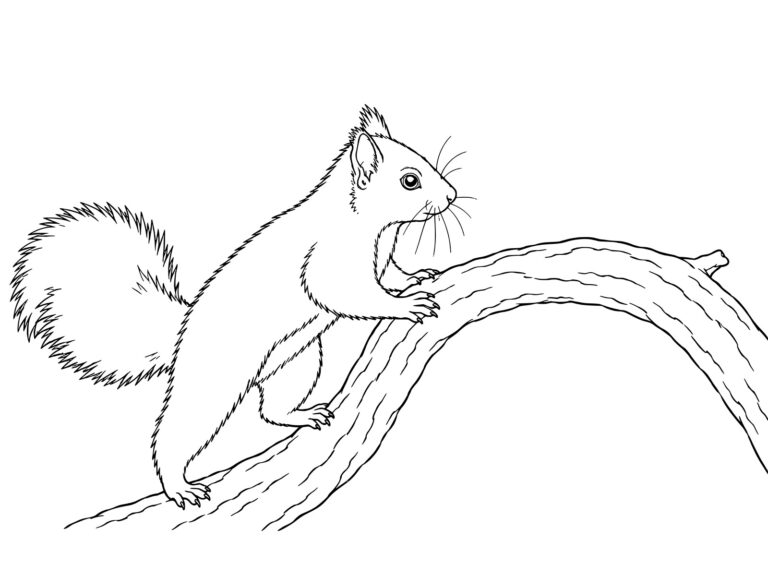
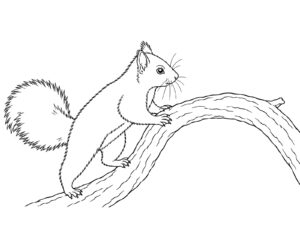
The first coloring page is a Japanese squirrel standing up with its front paws on a curved tree root.
Japanese squirrels change their fur between summer and winter.
In summer, their fur is reddish-brown, but in winter, it becomes fluffy and greyish-brown.
When they get their winter fur, the fur on the tips of their ears grows longer, making their ears look pointed.
Their tummy stays white all year round.
They can hold onto tree bark and branches tightly with the thin fingers on their front paws.
With their big eyes and straight ears, they quickly notice the sounds and moves around them.
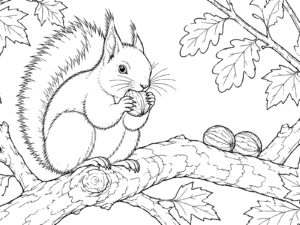
A squirrel gnawing a walnut
In the second page, the Japanese squirrel is sitting on an autumn branch, holding a walnut with both hands and gnawing on it.
There are two more walnuts on the branch.
Japanese squirrels use their sharp front teeth to gnaw open and eat even hard walnuts like heartnuts.
They also eat acorns, pine seeds, tree buds, and mushrooms.
When they eat, they sit on their back legs and use their front paws just like hands.
They turn the walnut round and round with both hands and gnaw it very well.
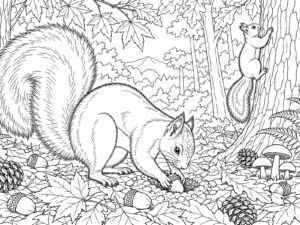
Burying acorns to get ready for winter
In the third page, a Japanese squirrel is burying an acorn in the ground in the autumn forest.
In the back, there is another Japanese squirrel climbing up a big tree trunk.
Acorns, pine cones, small mushrooms, and fern leaves are scattered on the ground.
Japanese squirrels do not hibernate, so they move around looking for food in winter too.
That is why they bury acorns and walnuts in many places in the ground during autumn to hide them.
Try making an autumn forest by combining this with the gathering acorns coloring page.
How to Color Japanese squirrel
For the winter fur, mix gray and brown
To give the Japanese squirrel its winter fur, layer light brown over gray to make it look just like winter.
Make the back darker and the sides lighter to make its body look nice and chubby.
Leave the tummy white like the paper.
If you want to make a summer Japanese squirrel, you can color the whole body reddish-brown instead.
If you make the tips of the front and back paws a little lighter than the body, you can see the thin toes clearly!
For the tail, follow the direction of the fur
The trick to the bushy tail is to move your colored pencil in small strokes along the direction of the fur.
Making the middle of the tail dark and the edges light gives it a soft, spread-out look.
If you leave a little white on the jagged fur at the edges, it will look super soft.
Color the eyes black and leave a small white shine in them.
Making the long fur at the tips of the ears a little darker than the body gives the ears that pointy winter look!
Colors of the autumn forest
Mix red, orange, yellow, and brown to color the fallen leaves and tree leaves cheerfully.
For acorns, color the nut brown and the cap dark brown to make them look real.
For walnut shells, trace the wrinkles with dark brown over light brown.
Color the tree trunk with brown or dark gray along the lines of the bark.
For the mushrooms on the third page, you can color them brown like shiitake mushrooms, or have fun using red or yellow!
Fun Facts About Japanese squirrel
Buried acorns grow the forest
In winter, squirrels find and eat the acorns and walnuts they buried in autumn.
But they cannot find every single one they buried.
Acorns and walnuts left uneaten sprout in spring and eventually grow into trees.
Without knowing it, squirrels help plant trees in the forest.
A leftover that looks like a "fried shrimp"
When the Japanese squirrel eats a pinecone, it nibbles off the scales neatly, leaving only the core.
That shape looks just like a fried shrimp.
If you find a "fried shrimp" on the forest floor, a Japanese squirrel might be nearby.
It is said that field mice leave similar leftovers too.
Foreign squirrels that look very similar
In some Japanese towns and parks, a squirrel called the Pallas's squirrel is increasing, which was not originally in Japan.
The Pallas's squirrel has short, round ears even in winter, and the fur on the tips of its ears does not grow long.
By looking at the shape of the ears, you can tell if it is a Japanese squirrel or not.
Another difference is that the Pallas's squirrel has a brownish belly.
Share These Japanese squirrel Coloring Pages


More Other Mammals Coloring Pages
-
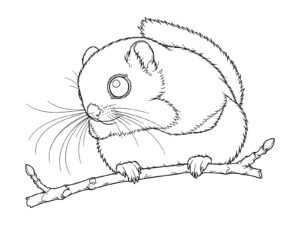
Japanese squirrel
-
Squirrel gnawing on a walnut
-
-
Autumn Forest Burying Acorns
-
-