Shinkansen Series 500 Coloring Pages
 ~

About Shinkansen Series 500
The First Shinkansen in Japan to Reach 300 km/h
Shinkansen Series 500 is a bullet train made by JR West.
It made its debut in 1997 as the "Nozomi" on the Sanyo Shinkansen line.
It was the very first Shinkansen in Japan to carry passengers at 300 km/h.
Back then, it was one of the fastest trains running in the world!
A Super Long, Pointy Nose
The coolest feature of Shinkansen Series 500 is its long, pointy nose.
When a Shinkansen zooms into a tunnel, it can cause a loud "boom" sound at the exit.
To stop that loud noise, the front was made long and thin.
People say this shape was inspired by the beak of a bird called the kingfisher, which can dive into water almost without making a splash!
A Driver's Seat Just Like a Fighter Jet
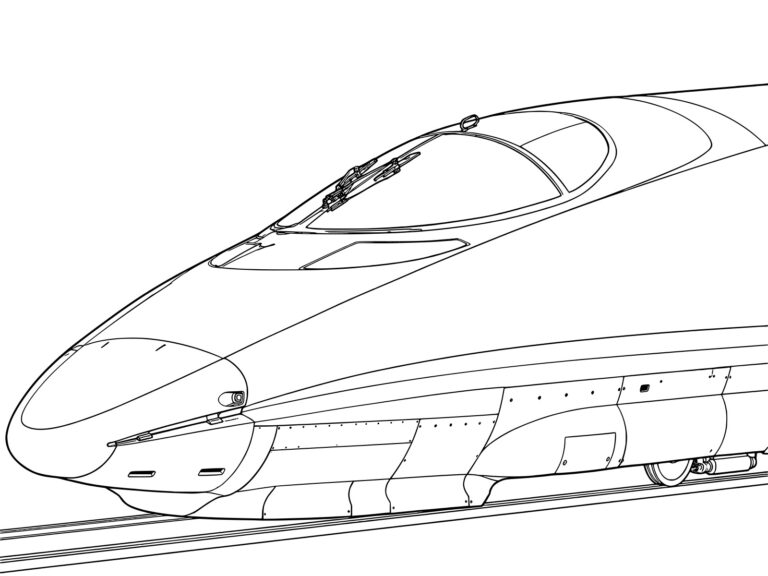
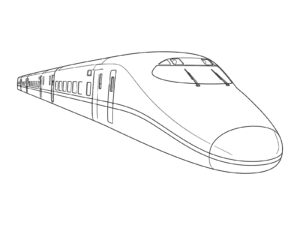
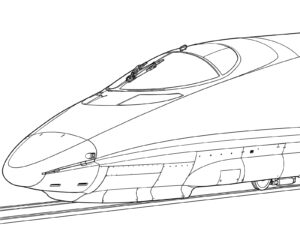
The first coloring page shows the front of Shinkansen Series 500 up close from an angle.
The windshield of the driver's seat looks like a long, round dome canopy, just like on a fighter jet!
If you look at the train from the front, it has a rounder, tube-like body than other Shinkansen trains.
Behind its long nose, you can peek a little bit of the wheels under the train body.
The front wheels are hidden behind the bottom edge, so you can't see them.
Shinkansen Series 500 Running Near a Station
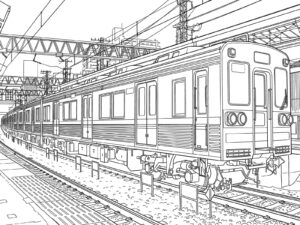
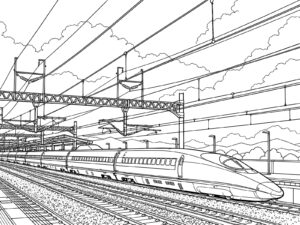
The second picture is a coloring page of Shinkansen Series 500 with 8 cars running near a station.
Today, Shinkansen Series 500 has 8 cars and runs as the "Kodama" train, stopping at every station.
Above the train, you can see the overhead wires that bring electricity and the steel poles holding them up.
Try to find the distant mountains and fluffy clouds in the sky, too!
Shinkansen Series 500 Stopped at a Snowy Platform
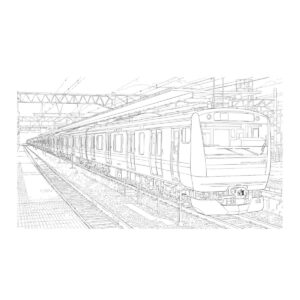
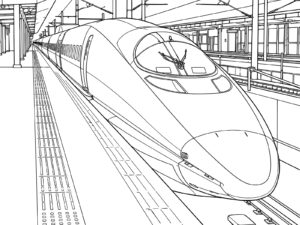
The third picture is a coloring page of Shinkansen Series 500 stopped at a train platform with a light layer of snow.
Looking at the front from almost straight ahead shows you just how long its nose really is!
You can also see the textured yellow blocks on the platform, as well as the roof and pillars of the station.
Try putting it next to the coloring pages for Doctor Yellow, which ran on the Sanyo Shinkansen line around the same time, and the N700 Series that came later, to compare their front shapes!
From 16 Cars to 8 Cars
When Shinkansen Series 500 first debuted, it was a super long train with 16 cars linked together!
After passing its job as "Nozomi" to newer trains, it was shortened to 8 cars and became the "Kodama."
How to Color Shinkansen Series 500
The Body Is Silver and Gray
The body of the Shinkansen Series 500 is bright silver.
If you use colored pencils, color it lightly with light gray and leave the shiny parts white. It will look shiny like real metal!
Let's color the long nose at the front in gray, too.
Around the Cockpit Is Blue
From around the cockpit window to the tip of the nose is colored dark blue.
If you color the window glass in light blue or dark blue and make the edges a little darker, it will look just like real glass.
Under the windows on the side of the train, there is a straight blue stripe.
The trick is to color the stripe carefully and straight, just like using a ruler!
The Wheels and Rails Are Dark Colors
On the 1st coloring page, if you color the wheels and the base in dark gray or black, the silver body will really stand out.
We recommend brown or gray for the rails, and dark brown for the railroad ties.
Show the Season with the Sky and Snow
On the 2nd coloring page, color the sky in light blue, leave the clouds white, and color the far-away mountains in light green or blue-green.
On the 3rd coloring page, leave the snow on the station platform white, or add shadows with light blue to make it feel like a chilly morning.
Color the tactile paving blocks in yellow.
Tricks to Make It Look Metallic
Even when using the same gray for the silver body, making dark areas and light areas will make it look like metal.
Try coloring the top of the long nose lightly, and the bottom part a little darker.
To get a neat finish, hold your pencil straight up so you don't leave any uncolored spots around the lines of the doors and inspection hatches!
Fun Facts About Shinkansen Series 500
The pantograph inspired by owl feathers
When Shinkansen Series 500 first debuted, the pantographs on the roof looked like the letter "T" or wings when viewed from above.
They had tiny ridges on the side.
These were inspired by owl feathers, which let owls fly silently, to help make the wind noise quieter.
Today's 8-car Shinkansen Series 500 uses a different type of pantograph.
A German designer joined the team
A German industrial designer named Alexander Neumeister helped design Shinkansen Series 500.
Its cool silver and blue colors are another secret to why Shinkansen Series 500 is so popular!
Planned to retire in 2027
JR West announced that Shinkansen Series 500 will retire in 2027.
It will run as a regular train until January 13, 2027. After that, it will run for special extra trips and finish its work in July 2027.
It is a wonderful bullet train full of memories that has been running for almost 30 years.
The driver's seat is small
Because the nose is so long and sharp, people say the driver's seat in Shinkansen Series 500 is smaller than in other bullet trains.
Share These Shinkansen Series 500 Coloring Pages


More Trains & Bullet Trains Coloring Pages
-
500 Series Shinkansen (3/4 view)
-
500 Series running near the station
-
-
500 Series at a Snowy Station Platform
-