Winter Solstice and Yuzu Bath Coloring Pages
 ~

About Winter Solstice and Yuzu Bath
The shortest day of the year
Winter Solstice is the shortest day and the longest night of the year.
It happens around December 22 every year, and in 2026, it is on December 22.
In Tokyo, the sun is up for less than 10 hours!
Compared to the summer solstice, daytime is about 5 hours shorter.
After Winter Solstice, the days slowly get longer again. People long ago thought this was a happy day because the power of the sun came back strong!
That is why there are many fun traditions on Winter Solstice to help you stay healthy all through the winter.
Winter Solstice is also one of the "24 Solar Terms," which split the year into 24 parts.
Yuzu and pumpkin
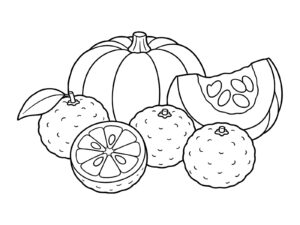
The first coloring page shows yuzu fruit and pumpkin, which are a big part of Winter Solstice.
Yuzu skin is bumpy and smells super nice!
When you look at a yuzu cut in half, you can see the sections and seeds inside.
There is a whole pumpkin and a cut pumpkin, too.
If you look at the inside of the cut pumpkin, you can see lots of seeds packed in the middle.
Pumpkins are picked in the summer, but they stay fresh for a long time. People ate them in winter when vegetables were hard to find to get strong and healthy!
Warm yuzu bath
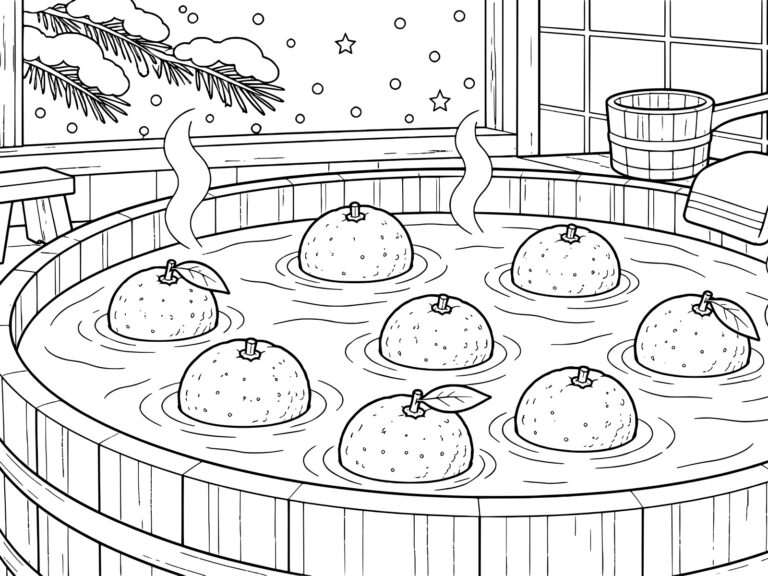
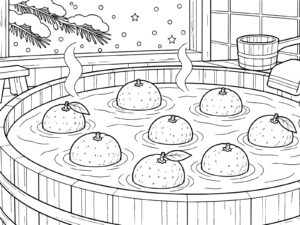
The second page shows a nice, warm yuzu bath.
Yellow yuzu fruits float in a wooden bathtub, and warm steam rises into the air.
On the edge of the tub, there is a small washbasin and a towel.
Outside the window, you can see snow on the pine tree branches and bright stars in the night sky.
Taking a yuzu bath warms up your whole body. People say it stops you from catching a cold!
It is a fun winter treat that feels totally different from getting warm under a kotatsu table.
The yummy smell of yuzu fills the whole bathroom, too!
Yummy foods with an "n"
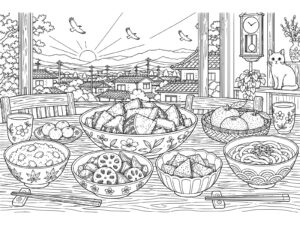
The third page shows a dinner table on the evening of Winter Solstice.
Outside the window, the sun is setting early.
On the table, there are simmered pumpkin, simmered carrots and lotus root, rice with ginkgo nuts, kumquats, konjac, and udon noodles.
All of these foods have the "n" sound in their Japanese names!
A cute cat is looking down at the dinner table from a shelf.
Eating a warm meal together is the best treat on a cold day!
How to Color Winter Solstice and Yuzu Bath
Color the yuzu yellow and orange
Color the yuzu with bright yellow, and layer some orange near the bottom to make it look round.
For the bumpy spots on the skin, add tiny dabs of a slightly darker color.
If you color the stem and leaf on top green, the yellow will look even brighter.
For a yuzu cut in half, color the rim of the skin yellow, the inside segments light yellow, and leave the seeds white.
Use different colors for the pumpkin skin and inside
Color the pumpkin skin dark green, and layer some blackish-green in places.
If you color the inside of the cut surface with orange and yellow, it will look super yummy.
Make the pulpy parts dark orange, and color the seeds cream color.
The bigger the difference between the green skin and the orange inside, the more the cut surface will stand out.
Color the stem dark brown or yellowish-brown.
The Yuzu Bath water and the sunset sky
On the second page, if you blend light sky blue and light yellow for the bathtub water, you can almost smell the yuzu scent.
Color the wood of the bathtub light yellowish-brown, and make the lines between the boards a little darker.
Leave the steam white, or use a very light gray.
On the third page, color the sunset sky orange and red near the horizon, and blend it into pink, purple, and light blue as you go up to make it look just like a winter evening.
If you color the floral patterns on the dinner table dishes with blue and red, it will look bright and lovely.
Fun Facts About Winter Solstice and Yuzu Bath
If it has an "n" sound, you get good luck
On Winter Solstice and Yuzu Bath, it is said that eating foods with the "n" sound in their name brings good luck.
This is called "Un-mori."
The kanji for pumpkin is written as "南瓜" and can be read as "nankin," so it has two "n" sounds!
Nankin (pumpkin), renkon (lotus root), ninjin (carrot), ginnan (ginkgo nut), kinkan (kumquat), kanten (agar), and undon are called the "Seven Foods of Winter Solstice and Yuzu Bath."
"Undon" means udon noodles.
Every single one has two "n" sounds in it!
Why do we take a yuzu bath?
There are a few stories about why people take a yuzu bath.
One story says that the strong smell of yuzu washes away bad things from your body.
Another story says it spread as a word game, matching "Touji" (Winter Solstice and Yuzu Bath) with "Touji" (hot spring cure), and "Yuzu" with "Yuuzuu" (smooth sailing).
It is said to have become popular at public bathhouses during the Edo period.
Red bean porridge, too
In some regions, people eat red bean porridge on Winter Solstice and Yuzu Bath.
People have long believed that the red color of red beans keeps bad things away.
In some places, people eat "Itokoni," which is pumpkin cooked with red beans.
Share These Winter Solstice and Yuzu Bath Coloring Pages


More Winter Events Coloring Pages

-
Yuzu and Pumpkin
-
Warm Yuzu Bath
-
-
Toji Dinner
-
-