Yokohama Line Coloring Pages
 ~

About Yokohama Line
Yokohama Line connects Yokohama and Hachioji
Yokohama Line is a JR train that runs from Higashi-Kanagawa Station in Kanagawa Prefecture, through Shin-Yokohama Station and Machida Station, all the way to Hachioji Station in Tokyo.
Many trains continue past Higashi-Kanagawa Station onto the Negishi Line, running toward Yokohama Station and Sakuragicho Station.
At Shin-Yokohama Station, you can transfer to the Tokaido Shinkansen.
There are many homes and green hills along the route, and the trains carry lots of people commuting to work and school.
A train line from over 100 years ago that carried raw silk
Yokohama Line was built in 1908 by a company called Yokohama Railway.
Back then, Japan sold a lot of raw silk overseas. Raw silk is thread used to make kimono and dresses.
This train line was built to carry raw silk from places like Hachioji and Gunma Prefecture to the Port of Yokohama.
Before the train line was built, people and horses carried raw silk over mountain paths.
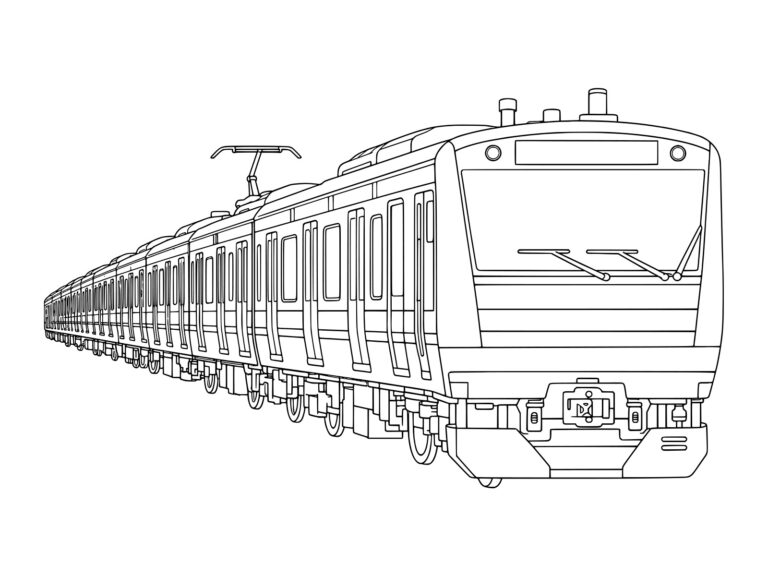
E233 Series with yellow-green and green stripes
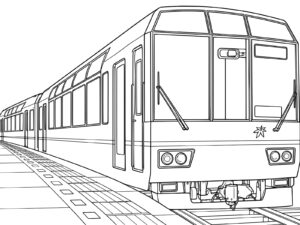
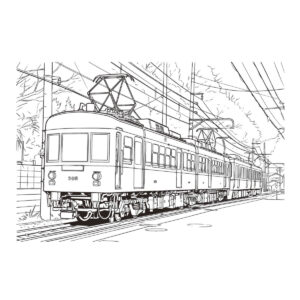
The first coloring page shows the E233 Series train on Yokohama Line.
The silver train body has two stripes: yellow-green and green.
On the front, the top half is large black glass, and the two stripes run across below it.
This train runs with 8 cars connected together.
Running past hills and homes
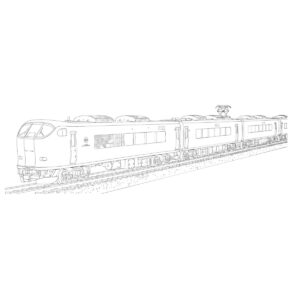
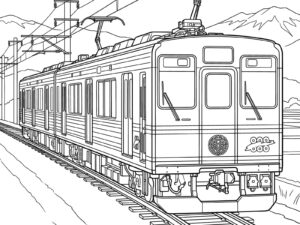
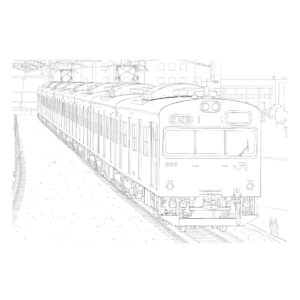
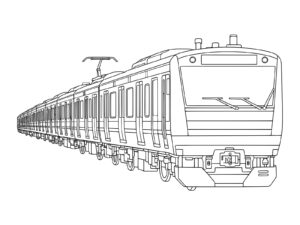
The second coloring page shows Yokohama Line running near a grassy, tree-covered hill.
Above the tracks, you can see rows of frames holding up the overhead wires.
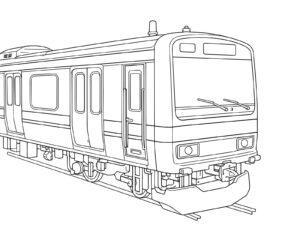
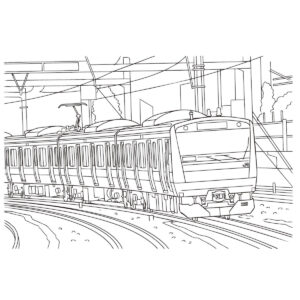
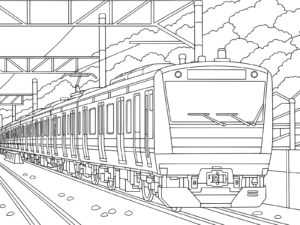
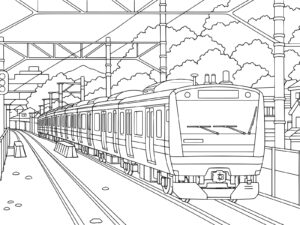
The third coloring page shows Yokohama Line running through a neighborhood in the morning.
There is a train signal next to the tracks, and you can see houses and trees in the back.
Two straight tracks stretch far into the distance.
Pantographs on the roof
On top of the train roof, there are pantographs shaped like diamonds or the letter V.
A pantograph touches the overhead wire above the tracks to take in electricity.
The train runs by using that electricity to turn its motors.
Try to find the pantographs and overhead wires in the coloring page!
Let's count the doors
Commuter trains have 4 doors on one side of each train car.
With many doors, lots of people can get on and off at once, so the train stops for a shorter time at each station.
Try counting the doors on the train in your coloring page, too!
How to Color Yokohama Line
Color the two stripes in different shades
The stripes on the Yokohama Line are two colors: a thin yellow-green on top, and a thick green on the bottom.
If you make the yellow-green bright and the green a bit darker, they will stand out clearly and look just like the real Yokohama Line!
It is also fun to compare them with the orange and green stripes on the Tokaido Line coloring page.
Silver train body and black windows
The train body is shiny silver stainless steel. Color it with a light gray, and leave a bit of the white paper showing to make it look shiny!
Color the big front window with dark blue or dark gray.
If you leave a thin white line near the top of the window, it will look like light is reflecting off it!
Color the lights yellow, and color the coupler and skirt dark gray.
Leave the box for the line logo above the stripes white.
Morning light and surrounding scenery
For the trees in the second and third pages, layer yellow-green and dark green together.
The third page shows a morning scene! Color the sky light blue or light orange to give it a lovely sunrise feel.
Color the roofs of the houses in any color you like, such as red or blue.
If you color the stones under the tracks gray and the rails brown, it will look super realistic!
Don't color the front window too dark
Instead of coloring the front window with just one flat color, try making the top darker and the bottom lighter. It will look just like real glass reflecting light!
Trace the windshield wipers thinly with dark gray to make them pop!
Fun Facts About Yokohama Line
The "Silk Road" and the Yokohama Line
In Hachioji City, a mountain path used for carrying raw silk still remains as the "Silk Road."
Before the Yokohama Line was built, raw silk was carried to Yokohama along this path.
After the Yokohama Line was built, trains started carrying the silk, so people used the mountain path less and less.
A Commuter Line with a Bullet Train Station
Shin-Yokohama Station was built in 1964 when the Tokaido Shinkansen opened.
Back then, rice fields and farm fields spread all around the area.
Now, it has become a busy town lined with big buildings and sports stadiums.
Line up your coloring page with the Keihin-Tohoku Line coloring page and compare the trains that run in Yokohama.
When the stripe colors are different, even trains with the same shape look totally different!
The Silver Train Body Does Not Rust Easily
Many JR commuter train bodies are made of a metal called stainless steel.
Stainless steel does not rust easily, so the whole body does not need to be painted.
Instead, colored stripes that are different for each line are taped on so you can tell which line the train belongs to.
Share These Yokohama Line Coloring Pages


More Trains & Bullet Trains Coloring Pages
-
Yokohama Line E233 Series
-
Yokohama Line running by a hill
-
-
Yokohama Line running through a residential area in the morning
-
-