Musashino Line Coloring Pages
 ~

About Musashino Line
Musashino Line loops around Tokyo
Musashino Line is a JR train that runs from Fuchū-Hommachi Station in Tokyo, through Saitama, to Nishi-Funabashi Station in Chiba.
It doesn't go through the middle of Tokyo. Instead, it runs in a big curve around the city.
Along the way, it crosses many other lines that run out from Tokyo, like the Chūō Line, Saikyō Line, and Jōban Line.
Because of this, Musashino Line is super handy! You can change trains to visit nearby towns without going all the way into the middle of Tokyo.
It started as a train line for cargo trains
At first, Musashino Line was built for cargo trains.
The tracks in central Tokyo were very busy with passenger trains. So, this line was made so cargo trains could travel around the city instead.
On April 1, 1973, passenger trains started running too, between Fuchū-Hommachi Station and Shin-Matsudo Station.
Even today, lots of cargo trains run on Musashino Line.
The E231 series with orange stripes
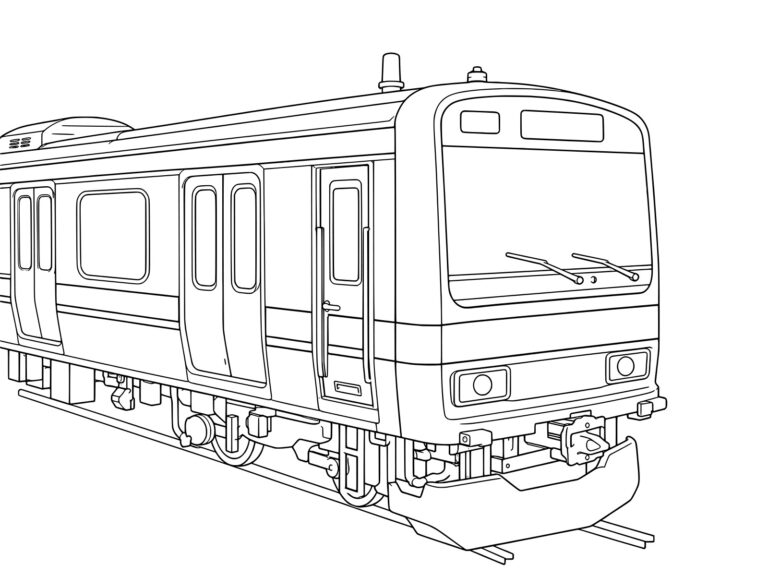
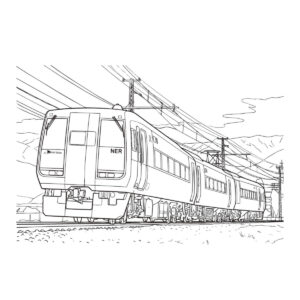
The first coloring page shows the Musashino Line E231 series stopped at a station.
It has a silver body with orange stripes.
Above and below the orange stripe, there are thin dark brown lines.
On the front, there is a round light on each side below the stripe.
Each train car has four big doors lined up on one side.
Curves and a Ferris wheel
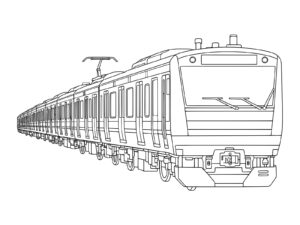
The second picture is Musashino Line coming around a curve surrounded by trees.
The long line of cars bends like a bow along the curve.
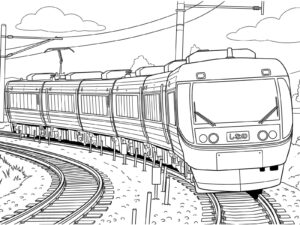
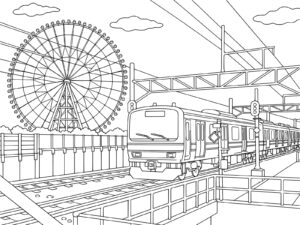
The third picture is Musashino Line running in front of a big Ferris wheel.
Some Musashino Line trains move onto the Keiyō Line at Nishi-Funabashi Station and run by the sea all the way to Tokyo Station.
Kasai Rinkai Park Station, which has the giant Ferris wheel, is on that path.
It's a fun spot where you can see the train and the Ferris wheel together!
Pantographs on the roof
On the train roof, you can see pantographs shaped like diamonds or sideways "V"s.
The pantograph touches the overhead wires above the tracks to get electricity.
The electricity makes the motor turn, and that is how the train moves!
Try to find the pantographs and overhead wires in your coloring page!
How to Color Musashino Line
3 Stripes of orange and dark brown
The stripes on the Musashino Line are a thick orange stripe in the middle, and thin dark brown stripes above and below it.
If you use a bright, yellowish orange, it will look just like the real train!
The dark brown lines are thin, so sharpen your colored pencil and color them carefully.
It is also fun to put it next to the Chuo Line (Rapid) coloring page, which has the same orange stripes, and compare the color differences!
Silver body and glass
The train body is stainless steel silver, so press lightly with a light gray pencil and leave a little bit of the white paper showing.
If you color the big glass window on the front with a dark blue or dark greenish gray, it will look just like real glass!
Color the lights yellow or white, and make the coupler dark gray.
Color the Ferris wheel brightly
For the Ferris wheel on the 3rd page, color the ring and frame white or gray, and use many colors like red, blue, and yellow for the gondolas to make it look fun and lively!
Color the sky a light sky blue, and leave the clouds white.
Color the posts supporting the Ferris wheel carefully with gray.
On the 2nd page, try layering yellow-green and dark green on the trees to make a lively summer forest.
If you color the rocks on the tracks gray and the rails brown, the train will really stand out!
Do not color the front glass too dark
Instead of coloring the front glass completely with just one color, try making the top dark and the bottom light. That way, it will look like light is reflecting on the glass!
If you trace the windshield wipers neatly with dark gray, they will show up clearly!
Fun Facts About Musashino Line
A Line with Lots of Tunnels
The Musashino Line was built with tunnels and elevated tracks to go over roads and other train tracks so that it doesn't need railroad crossings.
Around Fuchū-Hommachi Station, it goes through a tunnel under a high area of land called the Musashino Plateau.
It also goes under ground in tunnels where it crosses the Keio Line and Seibu Line.
Because there are no railroad crossings, there is less worry about hitting cars or people.
From some elevated stations, you can even see far out across the town!
The "Musashino South Line" Just for Freight Trains
The Musashino Line tracks keep going past Fuchū-Hommachi Station toward Tsurumi Station in Kanagawa Prefecture.
But only freight trains run on this section, so regular passenger trains don't run here.
The Musashino Line connects with the Nambu Line at Fuchū-Hommachi Station.
Sometimes you might see a long freight train passing by at a Musashino Line station.
Silver Train Bodies Don't Rust Easily
The bodies of many JR commuter trains are made of a metal called stainless steel.
Stainless steel does not rust easily, so the whole train body does not need to be painted.
Instead, colored stripes are put on the trains so you can tell which line each train belongs to.
Share These Musashino Line Coloring Pages


More Trains & Bullet Trains Coloring Pages
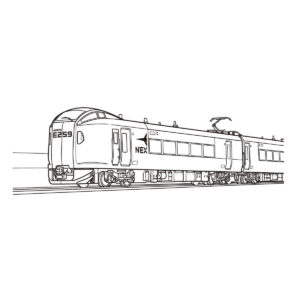
-
Musashino Line E231 Series
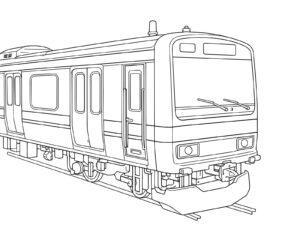
-
Musashino Line running on a curve
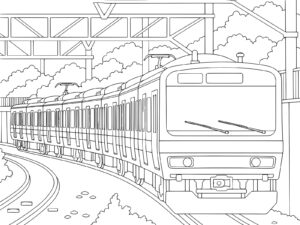
-
-
Ferris wheel and Musashino Line
-
-