Greater white-fronted goose Coloring Pages
 ~

About Greater white-fronted goose
Migratory birds that come to Japan in autumn
The Greater white-fronted goose is a big migratory bird in the duck family.
In summer, they raise their chicks in the cold northern lands of Russia.
Then, when autumn comes, they fly thousands of kilometers to come to Japan to spend the winter.
They arrive in Japan around October every year, and head back north when spring comes.
It is said that the Greater white-fronted goose travels together as a family and lives with its parents and chicks all winter long.
Swans are another kind of migratory bird that comes to Japan in winter just like them.
Look for the white forehead
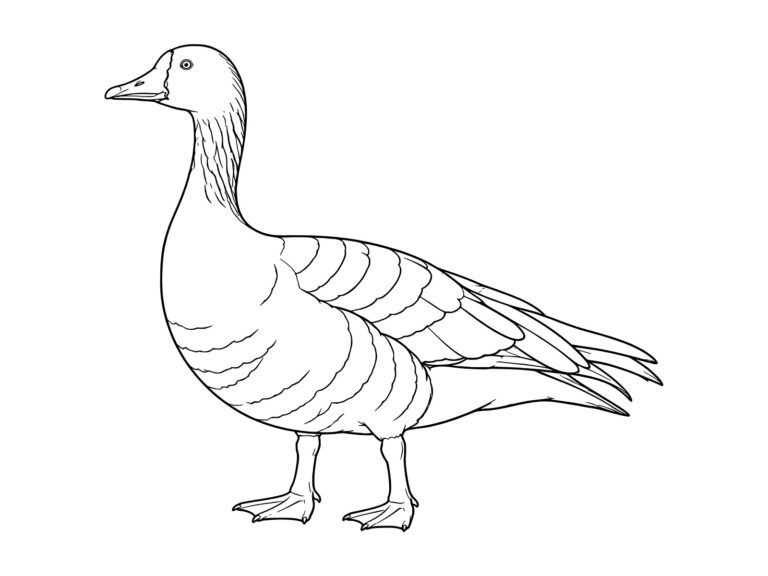
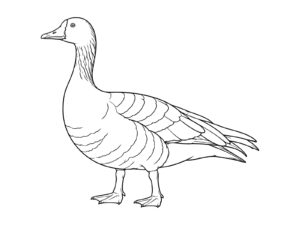
The 1st coloring page shows the Greater white-fronted goose from the side as it stands in a grassy field.
Its body is a greyish-brown color, and the feathers on its wings look like rows of fish scales.
The main thing to look for is the white patch from the base of its beak up to its forehead.
In English, it is named "White-fronted goose" because of this white forehead.
Its beak is pink, its legs are orange, and it has webbed feet between its toes.
It has black stripes across its belly.
These black markings become clearer as the bird grows into an adult.
Eating fallen rice grains in rice fields
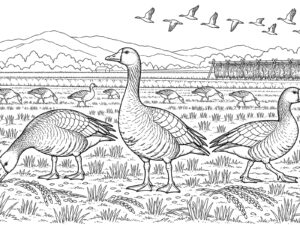
The 2nd coloring page shows a flock of Greater white-fronted goose looking for food in a rice field after the rice harvest.
Out of the three birds in front, one is pecking at the ground, one is stretching its neck to look around, and one is walking.
The Greater white-fronted goose eats rice grains that fell in the fields, as well as grass leaves.
Behind them, you can see racks used for drying rice and mountains far away.
You can also see another flock of Greater white-fronted goose flying in the sky.
Taking off all at once into the dawn sky
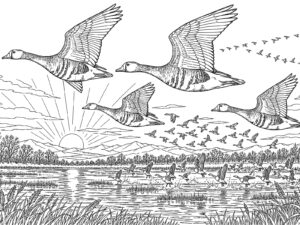
The 3rd coloring page shows the Greater white-fronted goose taking off from a marsh at dawn in winter.
At night, the Greater white-fronted goose sleeps together in a flock on the water of marshes and lakes.
Then, as the morning sun rises, thousands or tens of thousands of Greater white-fronted goose take off all at once and head for the rice fields.
This amazing view is called "Neguradachi" (leaving the roost), and you can see it at places like Lake Izu in Miyagi Prefecture.
High in the sky, you can also see a flock flying together in the shape of the letter V.
How to Color Greater white-fronted goose
Its body is a grayish brown
Color the Greater white-fronted goose's body grayish brown.
For the scale-like pattern on its wings, leave the edges whitish and color the middle a little darker. This makes the feathers look like they are overlapping one by one!
Color the black stripes on its belly with dark brown or black.
Leave the area under the base of its tail white.
If you make its neck and head a little darker brown than its body, it will look just like a Greater white-fronted goose.
A white forehead and a pink beak
Leave the paper white for the patch from the base of its beak to its forehead.
If you color the head around it dark brown, the white forehead will really stand out!
Color the beak pink and the legs orange.
Color the eyes black, and leave a tiny white spot for the light shine.
Color the webbed feet orange, just like the legs.
Rice field colors and the sunrise sky
For the second coloring page, color the harvested rice field with yellow-ocher and brown.
If you color the fallen rice ears yellow or gold, everyone can see what the Greater white-fronted goose is eating!
For the third coloring page, you can make a pretty sunrise sky. Color orange and yellow near the horizon, then pink, purple, and light blue as you go up!
Color the strip of light reflected on the water using the same colors as the sky.
If you color the reeds in front with dried yellow-ocher or brown, it will look like a cozy winter marsh.
Try the coloring page for the Red-crowned crane too! It is another bird that lives by the water.
Fun Facts About Greater white-fronted goose
More than 80% of Greater white-fronted goose visitors stay in Miyagi Prefecture
Most of the Greater white-fronted goose visitors that come to Japan spend the winter around Lake Izu-numa, Lake Uchi-numa, and Kabukuri-numa in Miyagi Prefecture.
Some studies show that more than 80% of the Greater white-fronted goose flock coming to Japan gathers in this area.
Rice fields stretch around these lakes, so they can sleep on the lakes at night and look for food in the fields during the day.
These lakes are registered under the Ramsar Convention as important wetlands for water birds.
A natural monument of Japan
The Greater white-fronted goose population once dropped a lot, so it was named a national natural monument.
Thanks to careful protection, many a Greater white-fronted goose can now come to Japan every year.
Why they fly in a V shape
Geese like the Greater white-fronted goose often fly in a V shape.
Riding the air currents made by the bird in front helps the birds behind fly a little easier.
They take turns leading the way on their long journey.
As they fly, they call out to each other with a "kwa-ha-han" sound to stay in touch.
Share These Greater white-fronted goose Coloring Pages


More Birds Coloring Pages
-
Greater White-fronted Goose
-
Greater white-fronted goose eating gleanings in a rice field
-
-
Roost departure at dawn
-
-