Ozoni Coloring Pages
 ~

About Ozoni
A Rice Cake Dish for New Year's
Ozoni is a soup with rice cakes that people eat on New Year's morning.
At the start of the year, families eat it together and wish for health and happiness for the year.
Many families eat it with Osechi food, too.
People say Ozoni started long ago by cooking and eating the rice cakes and vegetables offered to Toshigami, the New Year god.
It Changes a Lot by Region
The shape of the rice cakes, the soup flavor, and the ingredients in Ozoni are different depending on where you live and your family.
In Eastern Japan, people often put square toasted rice cakes in a soy sauce clear soup.
In Western Japan, people often boil round rice cakes without toast, and places like Kyoto use white miso soup.
In Kagawa, there is even sweet Ozoni with red bean paste inside the rice cakes in a white miso soup.
Seafood and Mountain Goodness Inside
In regions near the sea, there is Ozoni with fish or shellfish.
Niigata uses salmon and salmon roe, and Fukuoka sometimes uses yellowtail fish.
Since people add local foods, looking at Ozoni tells you a lot about that region.
It is fun to ask your friends or family, "What kind of Ozoni do you eat?"
When Do You Eat It?
People often eat Ozoni on the morning of New Year's Day, but some families eat it every morning during the first three days of the year.
People eat the rice cakes offered to Toshigami on New Year's Eve on the morning of New Year's Day.
Around New Year's, there are many days to eat rice cakes, like Nanakusagayu on January 7, and Kagami Biraki Oshiruko around January 11.
The special "Iwaibashi" chopsticks used for Ozoni are thin at both ends. People say one end is for you and the other end is for God.
How to Cut Rice Cakes
Square rice cakes are made by cutting a big flat sheet of rice cake. Round rice cakes are rolled by hand from fresh rice dough.
3 Coloring Pages
There are 3 coloring pages.
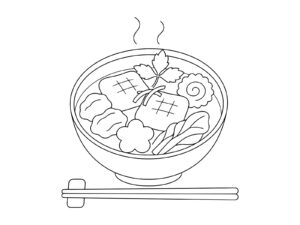
The first page is Kanto-style Ozoni with a square toasted rice cake, a swirl fishcake, and a carrot shaped like a flower.
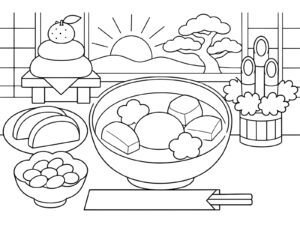
The second page is a New Year's morning dining table with round rice cake Ozoni, a Kagamimochi, and Kadomatsu lined up.
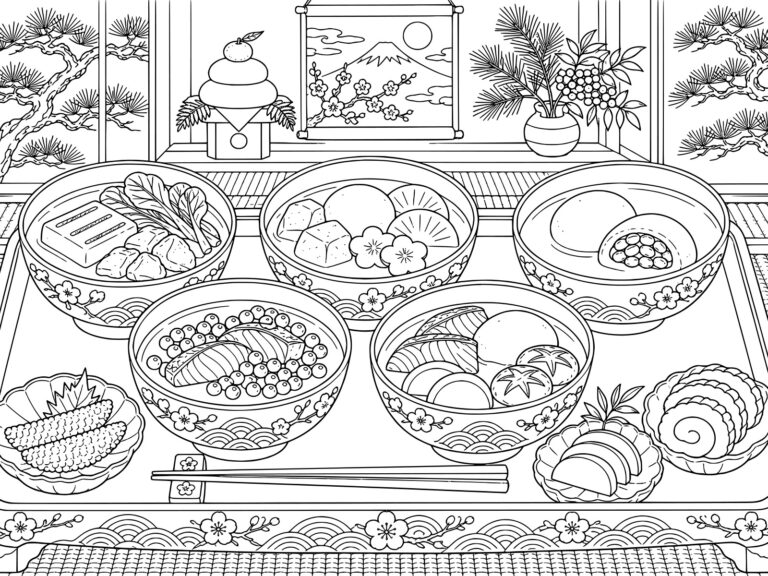
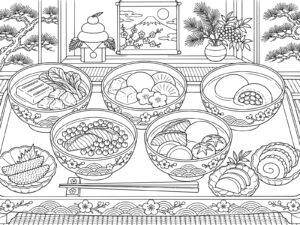
The third page is a detailed coloring page showing different types of Ozoni from across Japan.
Try the rice-cake making and Toshikoshi Soba coloring pages, too!
How to Color Ozoni
Leave the Rice Cake White
Leave the rice cake white and add light brown or ocher just on the toasted spots. Then it will look nicely baked!
For the puffy part, trace just the edge with light gray to make it look 3D.
The Soup Color Shows the Region
Use light yellow or light ocher for clear soup, and cream for white miso soup.
On the third page, if you change the soup color for each bowl, you can easily see how each Ozoni is different!
Sweet red bean paste is dark purple, salmon roe is orange, and salmon is light orange.
Make the Ingredients Colorful
Use orange for carrots, green for Komatsuna greens and Japanese parsley, and pink for the naruto swirl. This makes it bright and festive for New Year's!
Color the bowl red or dark brown close to black, and make the tray vermilion.
The bitter orange on top of Kagami Mochi is orange, and the bamboo of the Kadomatsu is green.
On the Third Page, Color One Bowl at a Time
On the third page, color one bowl at a time. Do the soup color first, then the ingredient colors.
It also looks pretty if you change the bowl patterns for each one, like red and gold, or blue and white.
Color the herring roe around the sides yellow, Datemaki egg roll yellow and orange, and Kamaboko fish cake pink and white.
If you color the Nanten berries in the flower arrangement red, it will feel just like New Year's!
Keep the Steam Light
Leave the steam white or add a light touch of light sky blue. Then you will have a piping-hot bowl of Ozoni!
Fun Facts About Ozoni
Round Mochi and Square Mochi
People say round mochi holds a wish for "the family to live together in peace and harmony."
Square mochi started in the city of Edo because flattening the mochi and cutting it let people make a lot of it quickly.
The Name "Ozoni"
Ozoni got its name because people "mix and cook" many different ingredients together.
Long ago, it was served not just at New Year's, but at any happy celebration.
Cut the Mochi into Small Pieces
Mochi can easily get stuck in your throat.
When young children or older people eat it, cut it into small pieces and make sure to chew slowly and well.
What the Ozoni Ingredients Mean
The ingredients in Ozoni also hold special wishes.
Taro brings many baby roots from one big root, so people wish for many children and grandchildren. Daikon radish grows deep roots, so people wish for their family to stay strong for a long time.
The red and white colors of naruto fish cake and kamaboko are happy colors for celebrations.
Regions Without Ozoni
Long ago, there were some areas where people did not eat mochi at New Year's. Some places welcomed the New Year by eating potatoes or soba noodles instead.
Share These Ozoni Coloring Pages


More Rice, Bread & Noodles Coloring Pages
More Winter Events Coloring Pages

-
Kanto-style Ozoni
-
New Year's morning ozoni
-
-
Ozoni from various regions of Japan
-
-